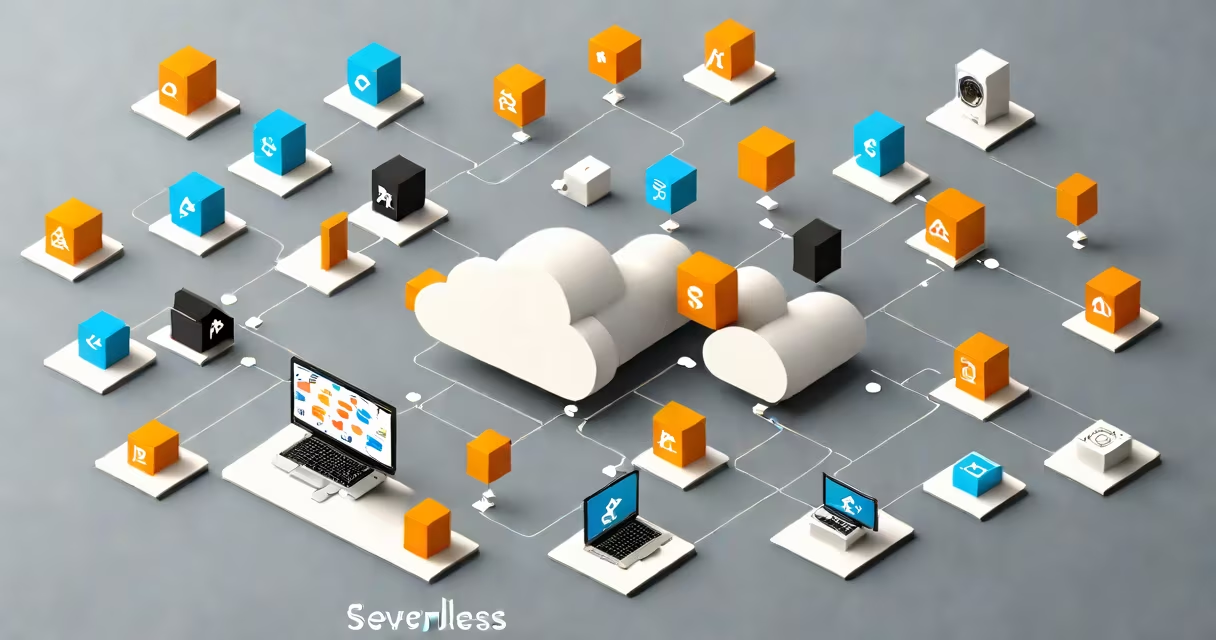
Serverless computing is a cloud execution model where the cloud provider manages infrastructure automatically, charging only for compute time consumed during execution. Developers upload code that runs in stateless containers, triggered by events.
When you deploy a serverless function, you're uploading code to a cloud platform that executes it in response to specific triggers. These triggers could be HTTP requests, database changes, or scheduled events. The cloud provider handles all the underlying infrastructure, including servers, operating systems, and resource allocation.
For example, AWS Lambda lets you run code without provisioning or managing servers. You write your function, set up a trigger (like an API Gateway call), and Lambda handles the rest. When the trigger fires, Lambda provisions the necessary resources, runs your code, and scales as needed.
Serverless systems typically consist of:
Serverless shines in scenarios requiring event-driven, scalable processing:
| Use case | Example |
|---|---|
| Real-time file processing | Resizing images uploaded to storage |
| Data transformation pipelines | Converting CSV files to JSON for analytics |
| Backend services for web/mobile apps | User authentication endpoints |
| Scheduled jobs | Nightly report generation |
Despite its name, serverless doesn't mean servers aren't involved - they're just abstracted away from developers. The cloud provider still uses physical servers to execute your code.
Another common myth is that serverless is only for small functions. While functions are typically short-lived, they can run for extended periods. For example, AWS Lambda functions can execute for up to 15 minutes.
Some developers worry about vendor lock-in with serverless. While each provider has unique features, core serverless concepts are portable across platforms like AWS Lambda, Azure Functions, and Google Cloud Functions.
Serverless pricing models charge for:
This pay-per-use model often results in lower costs for variable workloads compared to traditional server-based approaches. However, costs can escalate with frequent, short-duration functions.
For data-intensive applications, consider Databricks serverless compute which combines serverless simplicity with big data capabilities.
Serverless isn't suitable for all workloads. Consider these limitations:
For long-running processes or stateful applications, traditional server-based or containerized solutions may be more appropriate.