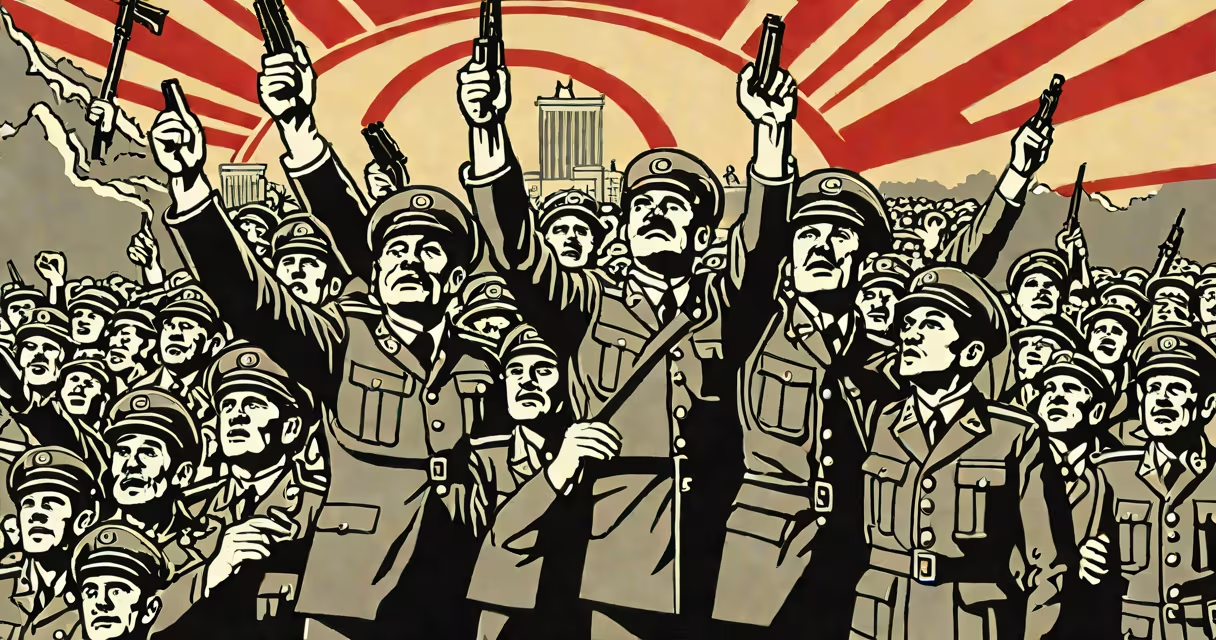
Communism is an economic and political system where all property and resources are collectively owned, eliminating private ownership and class divisions. However, it often fails due to inefficiencies, lack of incentives, and suppression of individual freedoms.
In theory, communism aims to create a classless society where everyone contributes according to their ability and receives according to their needs. This requires centralized planning and state control over all aspects of production and distribution.
While all communist systems share core principles, they differ in implementation:
| Type | Key Feature | Example |
|---|---|---|
| Marxist-Leninist | Vanguard party leads revolution | Soviet Union, China (early years) |
| Council Communism | Worker councils make decisions | Revolutionary Catalonia (Spanish Civil War) |
| Anarchist Communism | Stateless, voluntary associations | Makhnovshchina (Ukraine, 1918-1921) |
The most common criticisms of communism revolve around practical failures:
For example, the Soviet Union's command economy struggled with chronic shortages of consumer goods despite being a global superpower in military hardware. The system prioritized heavy industry over consumer needs, leading to widespread dissatisfaction.
Many people confuse communism with socialism, but they are distinct. Socialism allows for various forms of collective ownership while permitting some private enterprise. Communism, however, seeks to eliminate all private property.
Another misconception is that communism inherently leads to equality. While it aims for classlessness, in practice, communist regimes often create new elites within the party structure who enjoy privileges denied to ordinary citizens.
The most well-known examples of communist systems include the Soviet Union, Maoist China, and Cuba. Each faced significant challenges, including economic stagnation, political repression, and eventual collapse or reform.
For instance, the Soviet Union collapsed in 1991 due to economic inefficiencies, political corruption, and public discontent. Similarly, China abandoned many communist policies in the late 20th century to adopt market reforms.