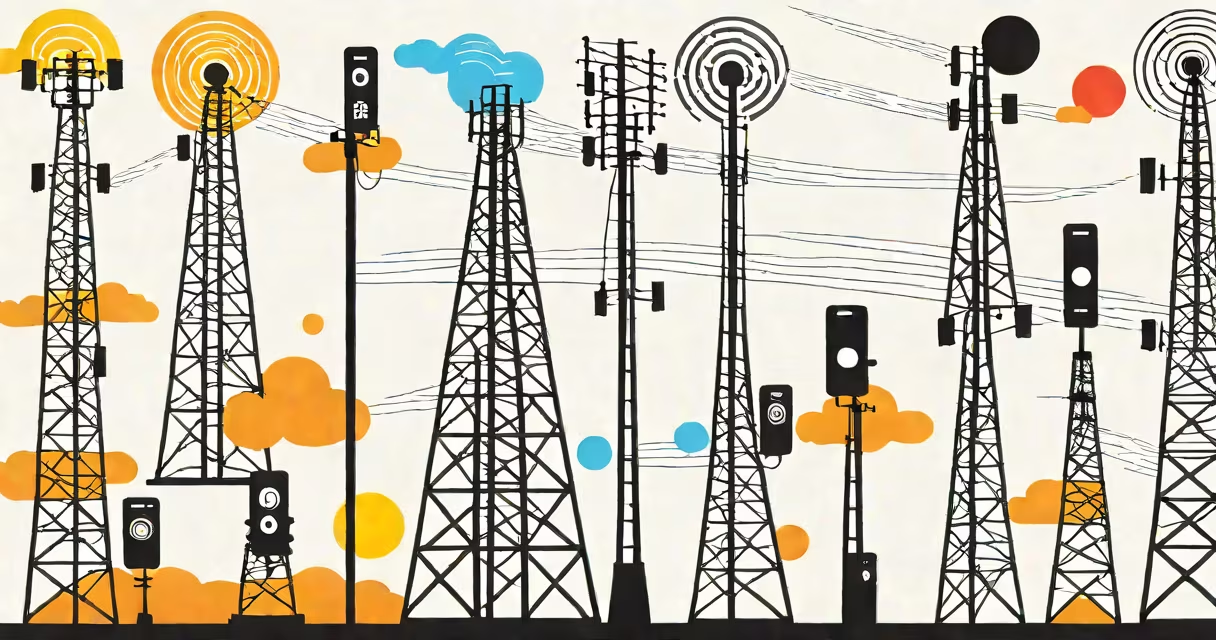
Cell phones use radio waves in specific frequency bands to communicate with cellular networks. These waves travel through the air at the speed of light, carrying voice calls, texts, and data between your phone and nearby cell towers.
Your phone contains multiple antennas that transmit and receive radio waves. When you make a call or use data, your phone converts your voice or digital information into radio signals. These signals travel to the nearest cell tower, which relays them to the network and to their destination.
The process works in reverse when receiving information. Cell towers broadcast continuous radio signals, and your phone listens for relevant transmissions using its antennas. When it detects a signal meant for you, it converts the radio waves back into usable information.
Different generations of cellular technology use distinct frequency ranges:
| Technology | Frequency Range | Common Bands |
|---|---|---|
| 2G | 850-960 MHz | 850 MHz, 900 MHz, 1800 MHz, 1900 MHz |
| 3G | 1700-2100 MHz | 1700 MHz, 1900 MHz, 2100 MHz |
| 4G LTE | 600-2600 MHz | 700 MHz, 1700 MHz, 1900 MHz, 2300 MHz, 2500 MHz |
| 5G | 600 MHz-28 GHz | 600 MHz, 2.5 GHz, 28 GHz, 39 GHz |
Lower frequencies (like 600 MHz) travel farther and penetrate buildings better, making them ideal for rural areas. Higher frequencies (like 28 GHz) offer more bandwidth for faster data speeds but have shorter range and poorer building penetration.
Most current networks use a combination of frequencies. For example, AT&T's network uses 1700 MHz, 1900 MHz, 2300 MHz, and 39 GHz bands simultaneously in many areas.
Many people confuse cell phone radio waves with other types of electromagnetic radiation. Unlike X-rays or gamma rays, cell phone waves are non-ionizing, meaning they don't have enough energy to remove tightly bound electrons from atoms or molecules.
Another common misconception is that cell phones create their own signals. In reality, they rely entirely on cell towers broadcasting continuous signals. Your phone simply responds to these existing broadcasts.
The Federal Communications Commission (FCC) regulates cell phone radiation levels. Phones must comply with specific absorption rate (SAR) limits, which measure how much radiofrequency energy is absorbed by the body. The current limit is 1.6 watts per kilogram averaged over one gram of tissue.
According to the World Health Organization, hundreds of studies have found no clear evidence that the weak radiofrequency signals from cell phones cause cancer or other health problems.
While working on a network optimization project, I used a spectrum analyzer to visualize the radio waves around me. The device showed constant activity across multiple frequencies, even in a quiet office environment. The strongest signals came from nearby cell towers, with weaker reflections bouncing off buildings.
This firsthand experience helped me understand how complex the wireless field is, with dozens of overlapping signals constantly competing for attention from our devices.