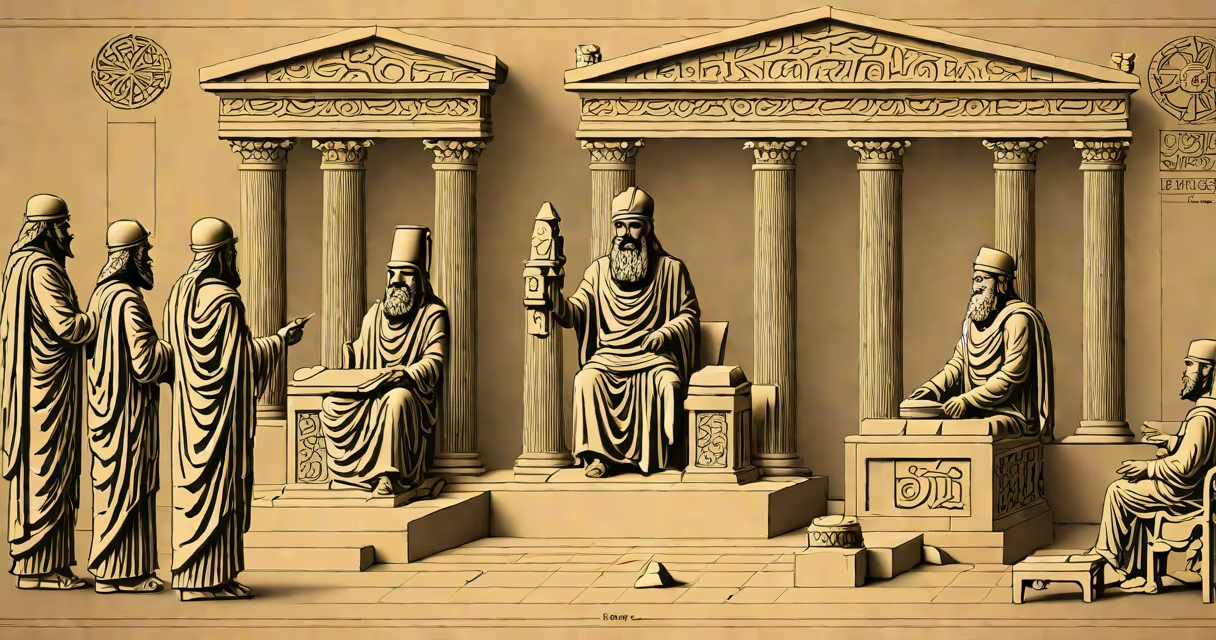
Hammurabi was the sixth king of Babylon (r. 1792-1750 BCE) who established one of history's earliest and most complete written legal systems, the Code of Hammurabi.
Hammurabi ascended to the throne around 1792 BCE, inheriting a kingdom from his father Sin-Muballit. He expanded Babylon's territory through military campaigns and strategic alliances, eventually creating the first Babylonian Empire. At its height, his empire included much of southern Mesopotamia and parts of modern-day Syria, Iran, and Turkey.
His most enduring legacy is the Code of Hammurabi, a well-preserved Babylonian law code of 282 case laws, inscribed on a seven-foot, four-ton diorite stele. The code includes provisions for family rights, property disputes, and commercial transactions, with penalties graded based on social status. "An eye for an eye" originates from this code, though it applied differently than modern interpretations suggest.
The code was discovered in 1901 at Susa (modern-day Iran) by French archaeologist Jacques de Morgan. It's now displayed at the Louvre Museum in Paris. A replica stands in front of the University of Pennsylvania's Law School.
While not the first legal code, Hammurabi's is the best preserved. It influenced later Mesopotamian law codes and demonstrates early concepts of justice, proportional punishment, and social hierarchy. Unlike earlier Sumerian laws, Hammurabi's code was systematically organized and widely distributed throughout his empire.
Modern legal historians debate whether it was primarily a symbolic statement of royal authority or an actively enforced legal system. Some provisions appear idealistic rather than practical, suggesting it may have served both purposes.
Beyond his legal code, Hammurabi:
After ruling for 42 years, Hammurabi died in 1750 BCE. His son Samsu-Ditana succeeded him but struggled to maintain the empire. Around 1595 BCE, the Hittites under King Mursili I sacked Babylon, ending Hammurabi's dynasty.
Despite this, Hammurabi's reputation endured. Later Mesopotamian kings claimed descent from him, and he remained a respected figure in Mesopotamian tradition.
Many believe Hammurabi's code was the first legal system, but earlier Sumerian city-states had legal traditions dating back to around 2600 BCE. Also, while the code includes harsh penalties, most cases likely involved fines or restitution rather than physical punishment.
Another myth suggests the code was universally applied, but its provisions actually reflected Babylon's social hierarchy, with different penalties for nobles, free citizens, and slaves.