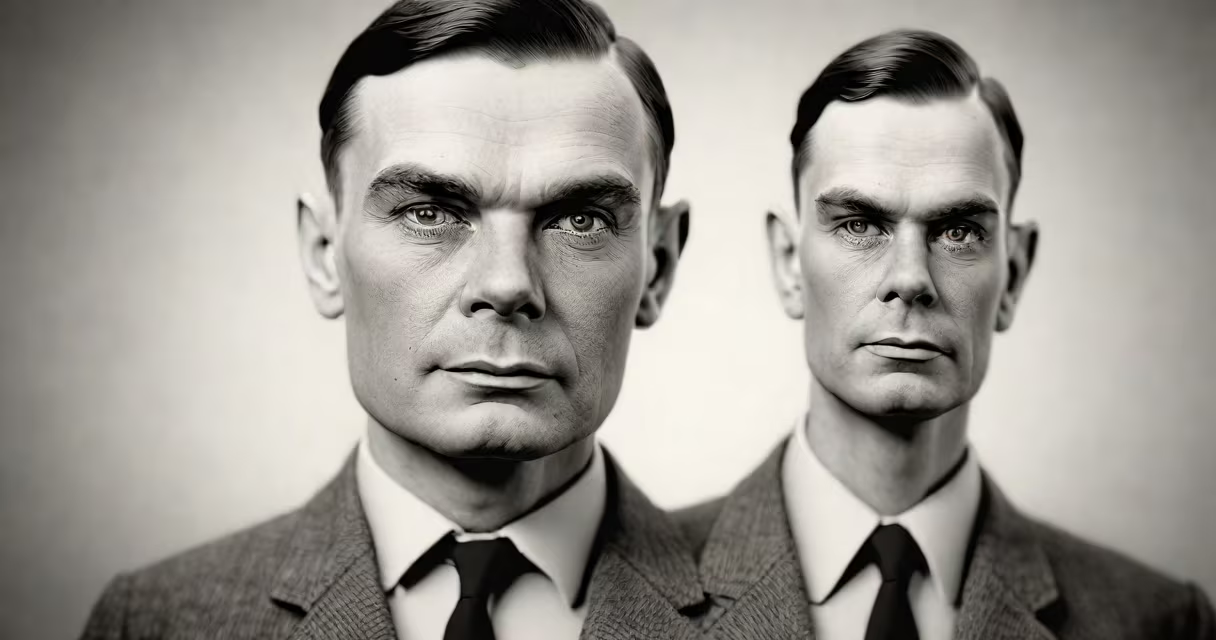
Alan Turing artificial intelligence refers to the pioneering work of British mathematician and computer scientist Alan Turing, who laid the theoretical groundwork for modern computing and artificial intelligence. His contributions include the concept of the universal machine, now known as the Turing machine, and the Turing test, which remains a fundamental benchmark in AI development.
The Turing machine is a theoretical model of computation that can simulate any algorithm, no matter how complicated. It consists of an infinite tape divided into squares, each holding a symbol, and a read/write head that moves based on a set of rules. This model demonstrates that any computation can be broken down into logical steps, a principle that underpins all modern computers.
Turing also introduced the concept of the universal machine, which can simulate any other Turing machine given its description. This idea is foundational to modern computing, as it shows that a single machine can perform any computational task, provided it has enough resources.
Turing's work spans several key areas:
One common misconception is that Turing invented the first computer. While he did design the Automatic Computing Engine (ACE), a stored-program computer, the first working stored-program computer was the Small-Scale Experimental Machine (SSEM), built by Tom Kilburn and Fred Williams at the University of Manchester in 1948.
Another myth is that Turing's work was solely theoretical. In reality, he contributed to practical applications, including codebreaking during WWII and the development of early computing machines.
Consider the Turing test. To pass, a machine must convince a human interrogator that it is human through a series of written questions. For example, if the interrogator asks, "What is the capital of France?" and the machine responds correctly with "Paris," it scores a point. The machine passes if it achieves a 50% success rate in convincing the interrogator it is human.
This test highlights Turing's focus on behavior rather than internal mechanisms. He argued that if a machine behaves intelligently, it is intelligent, regardless of how it achieves that behavior. This perspective remains influential in AI research today.
I once participated in a Turing test simulation at a tech conference. The AI responded to questions about literature, science, and even personal opinions with notable coherence. While it didn't fool everyone, it demonstrated how far AI has come since Turing's time.
Turing's contributions are foundational to modern computing and AI. His work in cryptanalysis helped end WWII, and his theoretical models laid the groundwork for all modern computers. The Turing test remains a benchmark for AI research, and his concepts of computability and universality are essential to understanding the limits and possibilities of computing.