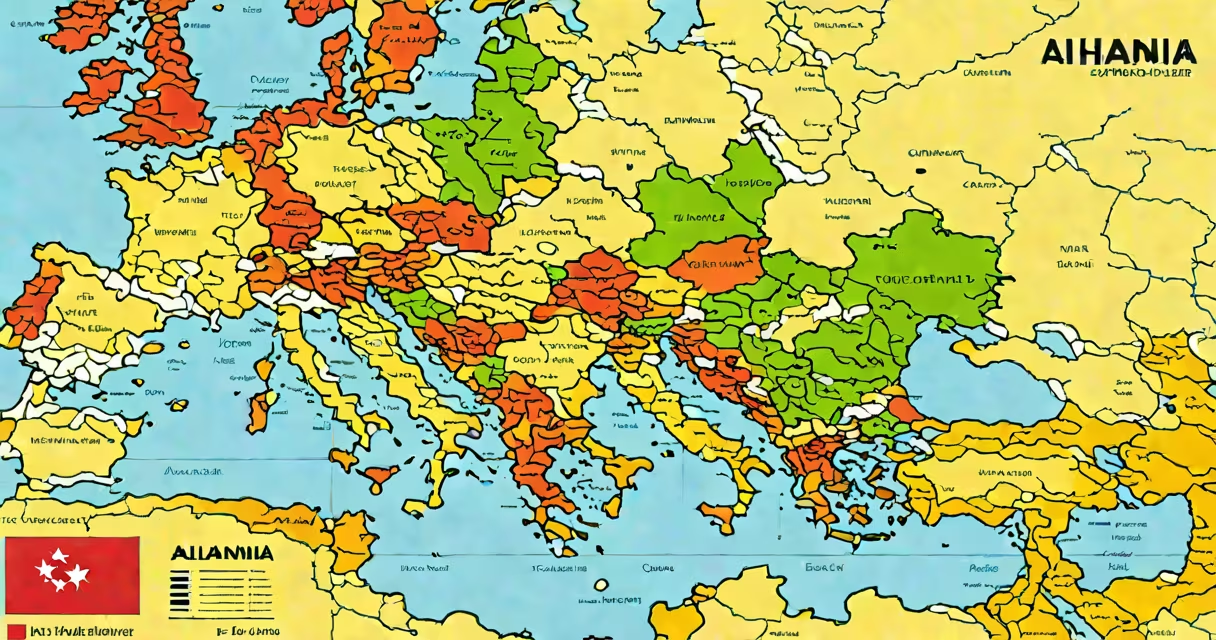
Albania is a country in Southern Europe on the Balkan Peninsula, bordered by Montenegro, Kosovo, North Macedonia, and Greece. Its western border is defined by the Adriatic and Ionian Seas.
Albania occupies 28,748 square kilometers in southeastern Europe. The country's strategic location along historic trade routes and its coastline have shaped its cultural and economic development. Albania's capital, Tirana, sits inland near the country's geographic center.
| Country | Border Length (km) |
|---|---|
| Montenegro | 172 |
| Kosovo | 112 |
| North Macedonia | 151 |
| Greece | 212 |
Albania shares maritime borders with Italy and Greece. The country's longest border is with Greece, running through mountainous terrain.
Albania's terrain includes the Albanian Alps in the north, central highlands, and coastal plains along the Adriatic Sea. The country's highest peak, Mount Korab, stands at 2,764 meters above sea level. Albania's coastline stretches 427 kilometers, featuring sandy beaches and dramatic cliffs.
Many people confuse Albania's location, assuming it borders Serbia or Bosnia and Herzegovina. While these countries are nearby in the Balkans, they do not share direct borders with Albania. Another frequent mistake is placing Albania entirely within the former Yugoslavia, though it was an independent communist state during that period.
When I visited Albania in 2019, I was struck by how the country's mountainous interior creates distinct microclimates. The coastal regions enjoy a Mediterranean climate, while inland areas experience more continental weather patterns. This geographic diversity contributes to Albania's varied ecosystems and agricultural products.
Albania's position in Europe has made it a crossroads for various civilizations throughout history, including Illyrians, Greeks, Romans, Byzantines, and Ottomans. This heritage is reflected in the country's archaeological sites, languages, and cultural traditions.