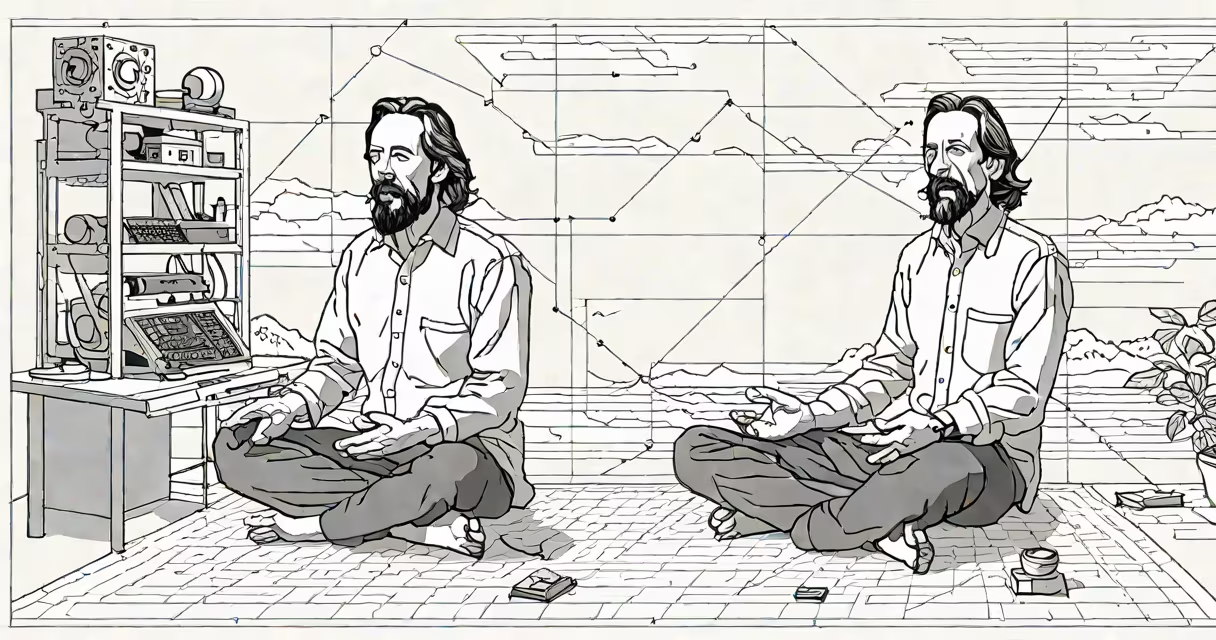
Alan Watts' method for meditation strips away religious dogma, focusing instead on awareness and presence. It begins with finding a comfortable position, closing your eyes, and observing your breath without trying to control it.
Watts framed meditation as "just sitting," emphasizing that the goal isn't to achieve a special state but to notice the ordinary one. His teachings often compared meditation to watching clouds pass-you don't try to push them away or hold them in place, you simply observe them.
This approach contrasts sharply with goal-oriented meditation practices. Watts warned against treating meditation like a task to complete or a skill to master. Instead, he encouraged practitioners to approach it with playful curiosity, like a child exploring a new toy.
While Watts didn't prescribe rigid techniques, his talks consistently emphasized three core elements:
Watts' approach appeals particularly to secular practitioners and those put off by religious connotations. His method works well in everyday settings-sitting on a park bench during lunch, waiting for a bus, or even lying in bed before sleep.
Many find it valuable for reducing stress and anxiety. A 2014 study published in JAMA Internal Medicine found that mindfulness meditation programs helped reduce symptoms of anxiety and depression. While Watts didn't focus on these benefits, his methods align with contemporary research on mindfulness.
Contrary to popular belief, Watts did not advocate emptying the mind. He acknowledged that thoughts would continue arising during meditation. The key was developing the ability to watch these thoughts without getting caught up in them-a skill he called "the art of seeing."
When I first tried this method, I was surprised by how quickly my mind wandered. But rather than judging myself for "failing," I followed Watts' advice to gently return attention to my breath. This process of returning became its own kind of practice.
To practice meditation as Watts suggested:
Watts' method differs from traditional meditation in its lack of prescribed postures, mantras, or specific goals. This makes it particularly accessible to Western audiences who might feel alienated by more formal practices. His teachings also emphasize the importance of humor and playfulness in meditation, which many modern guides overlook.
The simplicity of Watts' approach makes it easy to misunderstand as simplistic. However, the challenge lies in maintaining consistent awareness without trying to force any particular experience. As Watts himself put it, "The meaning of life is just being alive." The same could be said about his approach to meditation-the practice is simply being aware of the present moment.