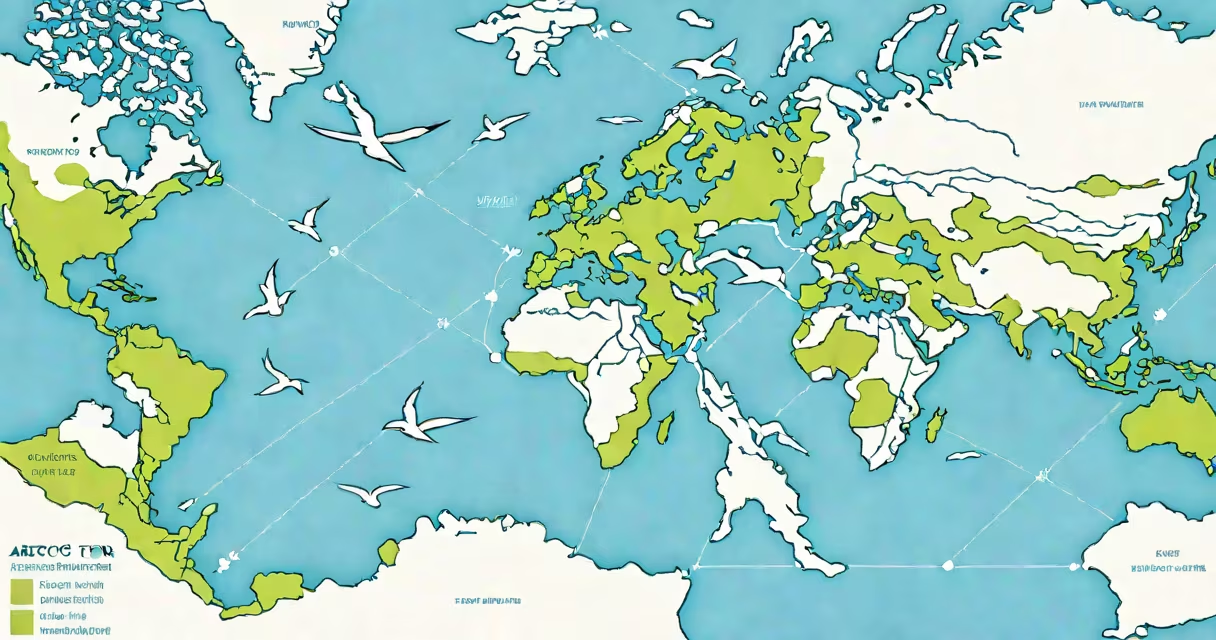
The arctic tern migration route map charts the circular path these seabirds take between Arctic breeding grounds and Antarctic wintering areas, covering up to 25,000 miles annually. This round-trip process makes them the champions of long-distance migration among animals.
Arctic terns follow a figure-eight pattern between poles, exploiting 24-hour daylight during northern summers to raise chicks, then flying south as days shorten. Their navigation relies on Earth's magnetic field, star patterns, and coastal landmarks. The entire population participates in this transoceanic relay.
| Location | Season | Key Fact |
|---|---|---|
| Arctic tundra (Greenland, Canada, Siberia) | May-August | Breeding season with 24-hour daylight |
| North Atlantic (Iceland, UK, Scandinavia) | September-October | Refueling stop before southern crossing |
| Southern Ocean (near Antarctica) | November-March | Wintering grounds with constant daylight |
| South Atlantic (Brazil, South Africa) | April-May | Northern return route varies by individual |
Scientists track these routes using lightweight geolocators attached to leg bands. A 2013 study in Proceedings of the National Academy of Sciences revealed terns may follow ocean currents and wind patterns for energy efficiency. Their process demonstrates extreme endurance: a 20-year-old tern may complete over 1.5 million miles in its lifetime.
Many assume terns fly nonstop between poles, but they actually make strategic stops to feed and rest. Satellite tracking shows they may linger weeks in key locations like the North Sea or Patagonian coasts when food is abundant.
During my visit to an Icelandic research station, I watched terns arrive daily at 5:30pm sharp to feed on plankton-rich waters near the coast. Their punctuality suggested reliance on predictable ocean currents rather than random foraging.
Climate change threatens this delicate system. Warming Arctic temperatures disrupt breeding timing, while overfishing depletes stopover feeding grounds. The International Union for Conservation of Nature lists the species as "Least Concern," but localized declines occur in some populations.
Protection efforts focus on preserving coastal wetlands and regulating fisheries in key migration corridors. Organizations like BirdLife International monitor population trends through citizen science programs.