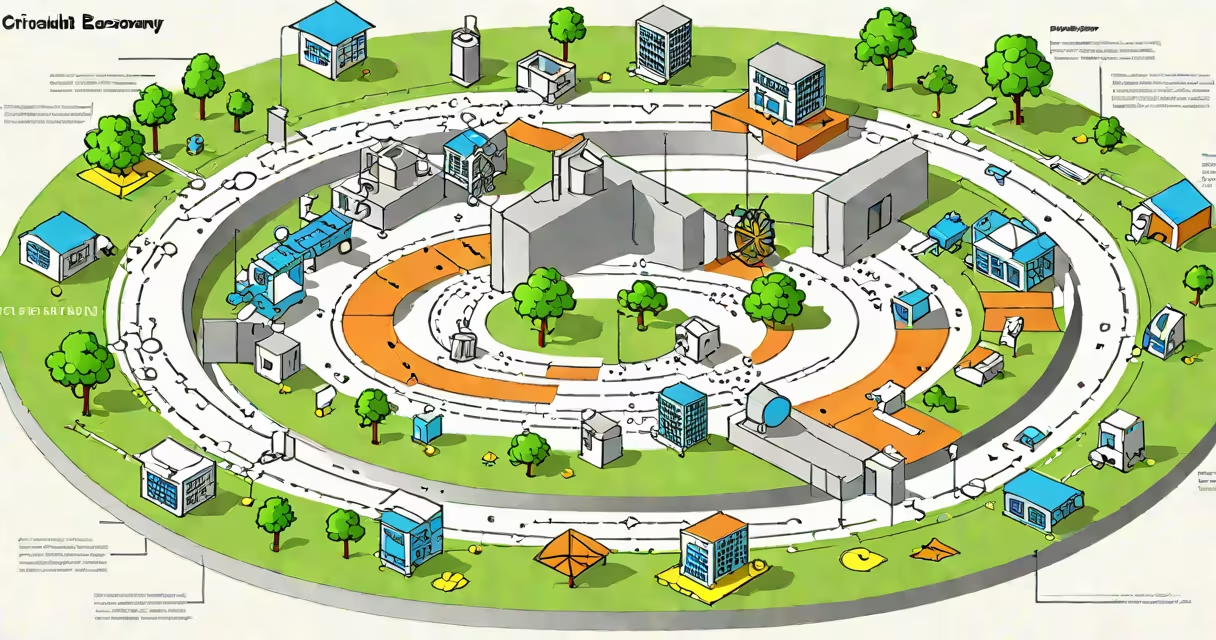
A circular economy model is a sustainable business structure that keeps resources in use as long as possible through reuse, repair, remanufacturing, and recycling. Unlike the linear "take-make-waste" system, it creates closed loops where materials continuously cycle back into production.
This approach addresses environmental concerns while maintaining economic growth. The Ellen MacArthur Foundation estimates that adopting circular practices could generate $4.5 trillion in economic benefits by 2030.
The model operates through three core principles:
For example, Patagonia's Worn Wear program extends clothing lifespans through repairs and resale, keeping materials in circulation rather than sending them to landfills.
| Type | Description | Example |
|---|---|---|
| Biological cycles | Compostable materials return to soil | Food scraps composted into fertilizer |
| Materials retain high value through multiple uses | Car parts remanufactured for new vehicles | |
| Product life extension | Products maintained and upgraded | Apple's trade-in program for electronics |
Many confuse circular economy with simple recycling. While recycling is part of the system, the model goes further by:
For instance, plastic waste management in a circular system isn't just about recycling - it involves designing packaging that's easily reusable or compostable, and creating collection systems that keep materials pure for reuse.
Transitioning requires systemic changes across industries. A major hurdle is the current infrastructure designed for linear systems. For example, most recycling facilities can't handle composite materials, making separation difficult.
However, new companies are finding solutions. Adidas' Futurecraft.Loop shoe is made entirely of recycled materials and can be fully recycled again after use. The company plans to scale this model across its product lines.
Government policies also play a important role. The European Union's Circular Economy Action Plan includes measures like extended producer responsibility, which makes manufacturers responsible for their products' entire lifecycle.
The circular economy model addresses critical global challenges:
According to the World Economic Forum, if adopted at scale, circular economy practices could reduce global greenhouse gas emissions by 3.7 billion tons annually by 2030 - equivalent to taking all cars in China and India off the road.
As businesses and consumers increasingly prioritize sustainability, the circular economy model offers a viable path toward economic growth that doesn't come at the expense of environmental health.