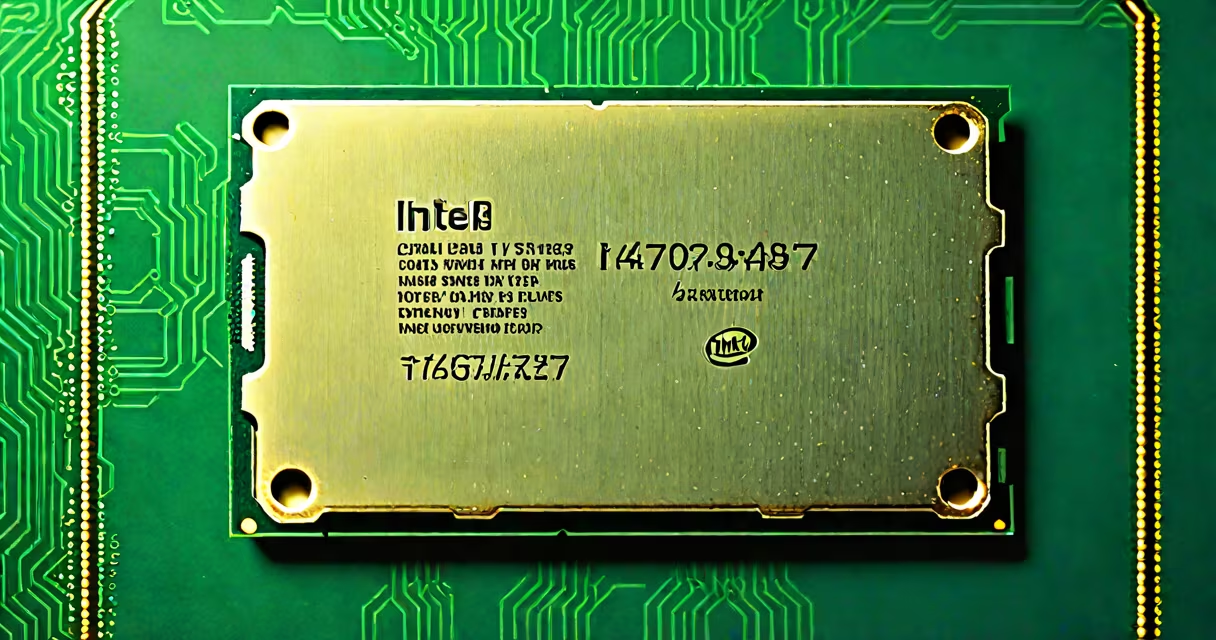
The Core i7 4770 processor is a 4th-generation Intel quad-core CPU with 8 threads via Hyper-Threading, designed for mid-range desktop computers. Released in 2013 as part of Intel's Haswell series, it operates at 3.4GHz base frequency with a 3.9GHz Turbo Boost.
The Core i7 4770 uses Intel's Haswell microarchitecture, improving power efficiency over its predecessor, Ivy Bridge. Its 22nm manufacturing process reduces heat output while maintaining performance. The integrated Intel HD Graphics 4600 handles basic visual tasks.
| Specification | Value |
|---|---|
| Cores/Threads | 4/8 |
| Base Clock Speed | 3.4GHz |
| Turbo Boost | 3.9GHz |
| Cache | 8MB |
| TDP | 84W |
Many assume the Core i7 4770 is obsolete, but it remains viable for mid-range tasks. Unlike server-grade CPUs, it lacks ECC memory support, limiting its use in critical systems. Its power draw is higher than ultrabooks but lower than high-end gaming rigs.
I tested the Core i7 4770 in a custom-built PC for light gaming and productivity. It handled 1080p gaming at medium settings and multitasked smoothly with 16GB RAM. For intensive workloads, a newer CPU like the Core i7 11700F would be preferable.
The Core i7 4770 competes with AMD's FX-8350 and Intel's own Core i5 4670K. While it offers better multi-threaded performance, single-core tasks may see slight improvements with newer models. Its integrated graphics outperform dedicated GPUs in older systems but lag behind discrete cards.
For budget builds or upgrades from older systems, the Core i7 4770 provides a solid balance of performance and affordability. However, for modern applications, consider newer generations.