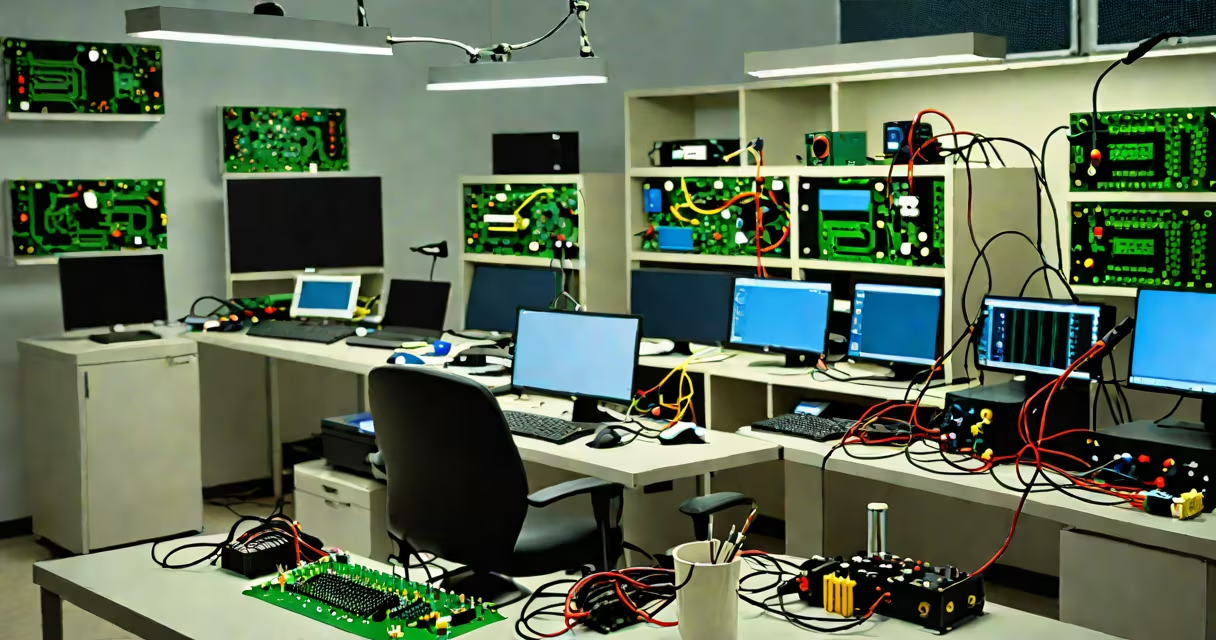
Electrical and computer engineering (ECE) is a branch of engineering that integrates electrical systems, computer science, and mathematics to design and develop technologies like microprocessors, communication networks, and control systems.
ECE merges theoretical principles with practical applications. Engineers in this field analyze problems, design solutions, and test prototypes using programming languages, simulation software, and hardware tools. For example, designing a smartphone involves creating circuits, programming software, and ensuring the device meets power and performance standards.
| Type | Focus Area | Example Applications |
|---|---|---|
| Electrical Engineering | Power systems, control systems, and electromagnetics | Electric grids, renewable energy systems, and electric vehicles |
| Computer Engineering | Computer architecture, embedded systems, and software engineering | Microprocessors, IoT devices, and cybersecurity systems |
| Signal Processing | Analyzing and manipulating signals | Audio and video compression, medical imaging, and radar systems |
| Telecommunications | Data transmission and network design | 5G networks, satellite communications, and fiber optics |
ECE is essential in industries like healthcare, automotive, aerospace, and consumer electronics. For instance, autonomous vehicles rely on ECE for sensor integration, real-time processing, and decision-making algorithms. According to the U.S. Bureau of Labor Statistics, employment in ECE-related fields is projected to grow 5%, driven by advancements in technology and increasing demand for smart devices.
Many people confuse ECE with purely electrical engineering or computer science. While ECE overlaps with both, it uniquely combines hardware and software expertise. For example, an ECE engineer might design a microcontroller for a medical device, requiring knowledge of both circuit design and programming.
A smart thermostat integrates sensors, microcontrollers, and wireless communication. An ECE engineer would design the circuit board, program the firmware to read temperature data, and implement Wi-Fi connectivity for remote control. The engineer would also ensure the device operates efficiently within power constraints, demonstrating the interdisciplinary nature of ECE.
I once worked on a project to develop a prototype smart thermostat. The process involved selecting components, writing code in C++, and testing the device under various conditions. This hands-on experience highlighted the importance of both hardware and software skills in ECE.