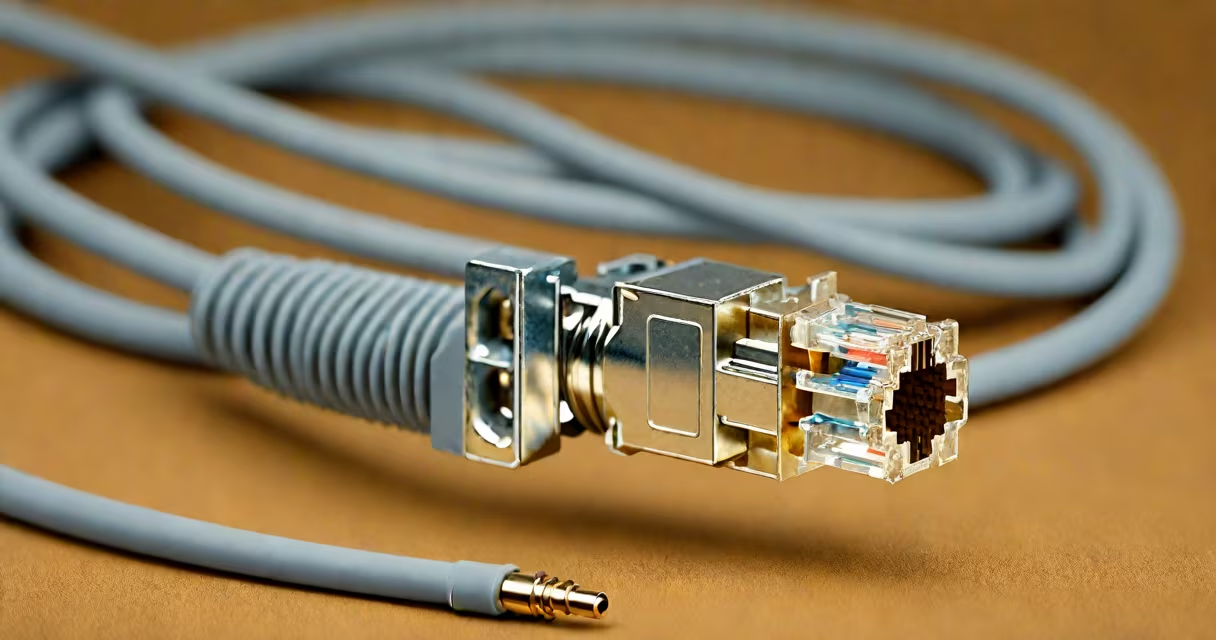
Ethernet 100Base-TX is a Fast Ethernet standard that transmits data at 100 Mbps using two pairs of twisted cables over distances up to 100 meters. It was introduced in 1995 as part of the IEEE 802.3u standard.
100Base-TX uses two wire pairs: one for receiving data and one for transmitting. It employs a technique called pulse amplitude modulation (PAM) to encode data, allowing for higher speeds than traditional Ethernet (10Base-T). The standard requires auto-negotiation, which enables devices to automatically adjust their settings for optimal communication.
While 100Base-TX is the most common implementation, other variants exist:
| Type | Cable Type | Distance |
|---|---|---|
| 100Base-TX | Category 5 or better twisted pair | Up to 100 meters |
| 100Base-FX | Fiber optic | Up to 400 meters (2 kilometers with repeaters) |
| 100Base-T4 | Category 3 twisted pair | Up to 100 meters |
100Base-TX became the dominant standard for local area networks (LANs) in the late 1990s and early 2000s. It is still widely used in:
A common misconception is that 100Base-TX requires four wire pairs. In reality, it only needs two pairs, unlike 100Base-T4, which uses all four pairs. Another mistake is assuming that 100Base-TX is obsolete. While newer standards exist, 100Base-TX remains relevant for many applications due to its balance of cost and performance.
When setting up a home network in 2005, I used 100Base-TX to connect computers, printers, and a shared internet connection. The setup was straightforward, and the performance was adequate for web browsing, file sharing, and basic multimedia streaming. Even today, many home routers include 100Base-TX ports alongside faster options.