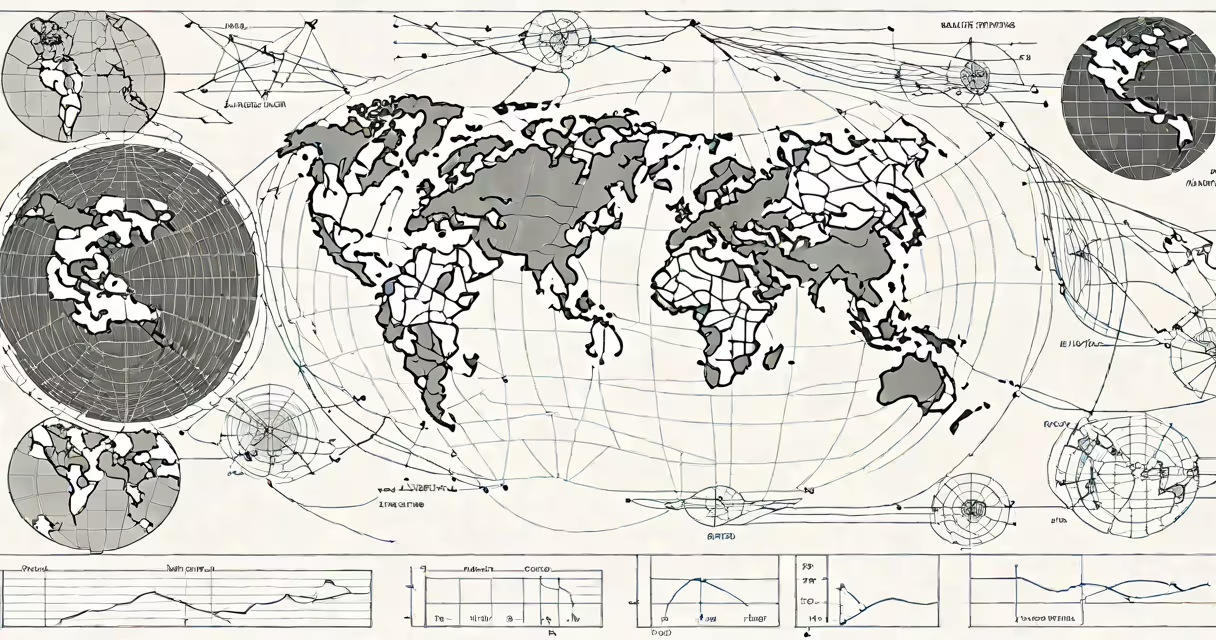
Global wind patterns are large-scale air movements driven by Earth's rotation and solar heating, creating consistent wind belts that shape climate and weather systems worldwide. These patterns form part of Earth's atmospheric circulation cells, which transfer heat from equatorial regions toward the poles.
The primary driver of global wind patterns is solar energy. The sun heats Earth's surface unevenly, creating temperature differences that generate pressure zones. Warm air rises at the equator, creating low-pressure areas, while cooler air sinks at higher latitudes, creating high-pressure areas. Earth's rotation deflects these air masses through the Coriolis effect, creating curved wind patterns rather than straight north-south flows.
Three main circulation cells dominate Earth's atmosphere: the Hadley cell (near the equator), the Ferrel cell (mid-latitudes), and the Polar cell (near the poles). These cells interact to create the major wind belts: the trade winds, the westerlies, and the polar easterlies.
| Wind Belt | Location | Direction | Characteristics |
|---|---|---|---|
| Trade Winds | Between 0° and 30° latitude (both hemispheres) | Northeast in Northern Hemisphere, southeast in Southern Hemisphere | Steady, reliable winds that historically helped ships trade between continents |
| Westerlies | Between 30° and 60° latitude (both hemispheres) | Southwest in Northern Hemisphere, northwest in Southern Hemisphere | Prevailing winds that drive extratropical cyclones and influence weather in North America, Europe, and Asia |
| Polar Easterlies | Above 60° latitude (both hemispheres) | East | Cold, dry winds that originate near the poles |
Understanding global wind patterns is important for weather forecasting, aviation, and maritime navigation. Sailors have used these wind systems for centuries to cross oceans efficiently. Modern applications include optimizing wind farm locations for renewable energy generation and predicting storm paths.
For example, the trade winds enabled European explorers like Christopher Columbus to cross the Atlantic Ocean. Today, these same winds help ships traveling from East Asia to North America save fuel by using favorable wind conditions. Wind farms in the U.S. and Europe often rely on the westerlies to generate consistent power.
Many people confuse global wind patterns with local winds like sea breezes or mountain winds. While local winds are influenced by topography and daily temperature changes, global wind patterns are driven by large-scale atmospheric circulation and Earth's rotation.
Another misconception is that wind always blows from high-pressure areas to low-pressure areas in a straight line. In reality, the Coriolis effect causes winds to deflect to the right in the Northern Hemisphere and to the left in the Southern Hemisphere, creating curved paths.
During a sailing trip from the Canary Islands to the Caribbean, I experienced the trade winds firsthand. For days, our boat consistently encountered northeast winds, which propelled us westward at a steady pace. The reliability of these winds made the process smoother than expected, demonstrating the practical applications of understanding global wind patterns.
According to the National Oceanic and Atmospheric Administration (NOAA), global wind patterns play a critical role in redistributing heat around the planet. Without these patterns, equatorial regions would become even hotter, and polar regions would be colder. This balance is essential for maintaining Earth's climate system.