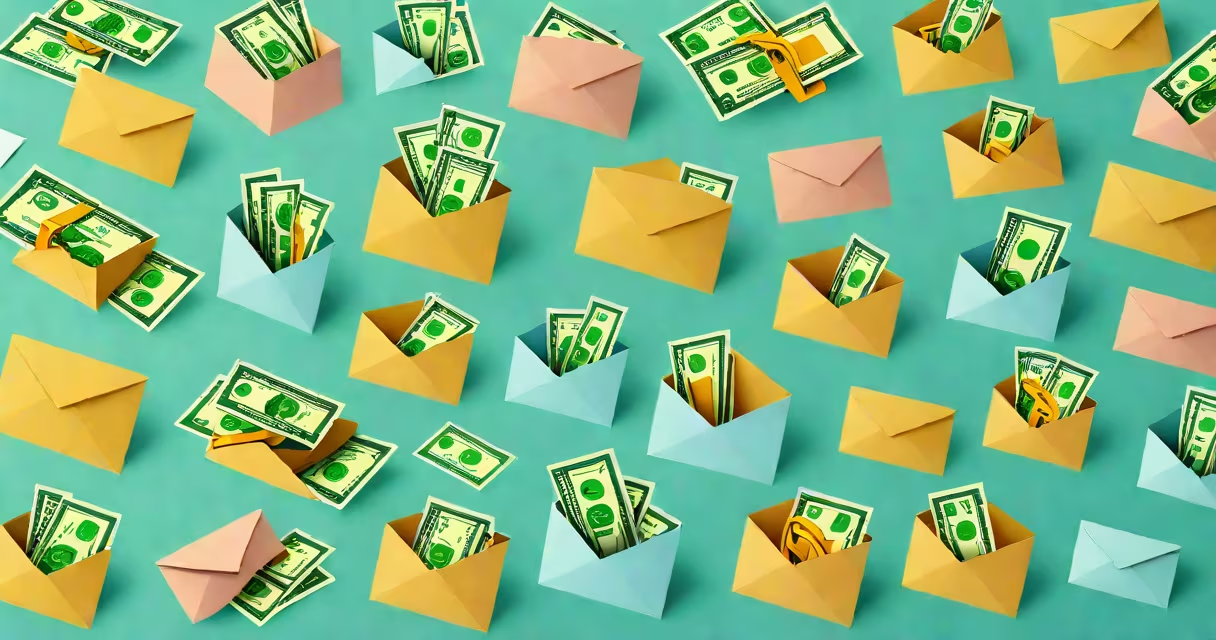
Envelope budgeting is a cash-based budgeting method where you allocate specific amounts of money to different spending categories using physical envelopes. Each envelope represents a budget category, such as groceries, entertainment, or transportation.
To start envelope budgeting, you first determine your monthly income and fixed expenses. Then, you create envelopes for each of your variable spending categories. You withdraw the total amount of cash needed for all your variable expenses and divide it among the envelopes according to your budget.
For example, if your monthly income is $3,000 and your fixed expenses (like rent and utilities) total $1,500, you have $1,500 left for variable expenses. If your variable expenses include $400 for groceries, $200 for entertainment, and $300 for transportation, you would create three envelopes and put the corresponding amounts of cash into each one.
The types of envelopes you create will depend on your personal spending habits and financial goals. However, some common categories include:
Envelope budgeting is used by individuals and families who want to gain better control over their spending and save money. It is particularly useful for those who struggle with overspending or who prefer a tangible, visual way to track their expenses.
According to a study by the Federal Reserve, about 76% of Americans use some form of budgeting method, and envelope budgeting is one of the most popular. It is also commonly used by people who want to pay off debt or save for a specific goal, such as a vacation or a down payment on a house.
One common misconception about envelope budgeting is that it is outdated or only suitable for those who prefer to use cash. While it is true that envelope budgeting involves using physical cash, it can also be adapted to work with digital banking. Some people use virtual envelopes within their bank's mobile app or budgeting software to achieve the same effect.
Another misconception is that envelope budgeting is too rigid or restrictive. In reality, the method is highly customizable and can be adjusted to fit your individual needs and financial goals. For example, you can create additional envelopes for irregular expenses, such as car maintenance or medical bills, or adjust the amounts in your envelopes as your income or expenses change.
I tried envelope budgeting for three months to see if it would help me save money and reduce my spending on non-essential items. I created envelopes for groceries, dining out, entertainment, and transportation, and I withdrew the corresponding amounts of cash from my bank account. I found that having a limited amount of cash in each envelope made me more mindful of my spending and helped me avoid impulse purchases. By the end of the three months, I had saved an extra $300 and reduced my spending on non-essential items by 20%.
Envelope budgeting is a simple and effective way to control your spending and save money. By allocating specific amounts of cash to different spending categories and using physical envelopes to track your expenses, you can gain better control over your finances and achieve your financial goals. Whether you prefer to use cash or digital banking, envelope budgeting can be adapted to fit your individual needs and preferences.