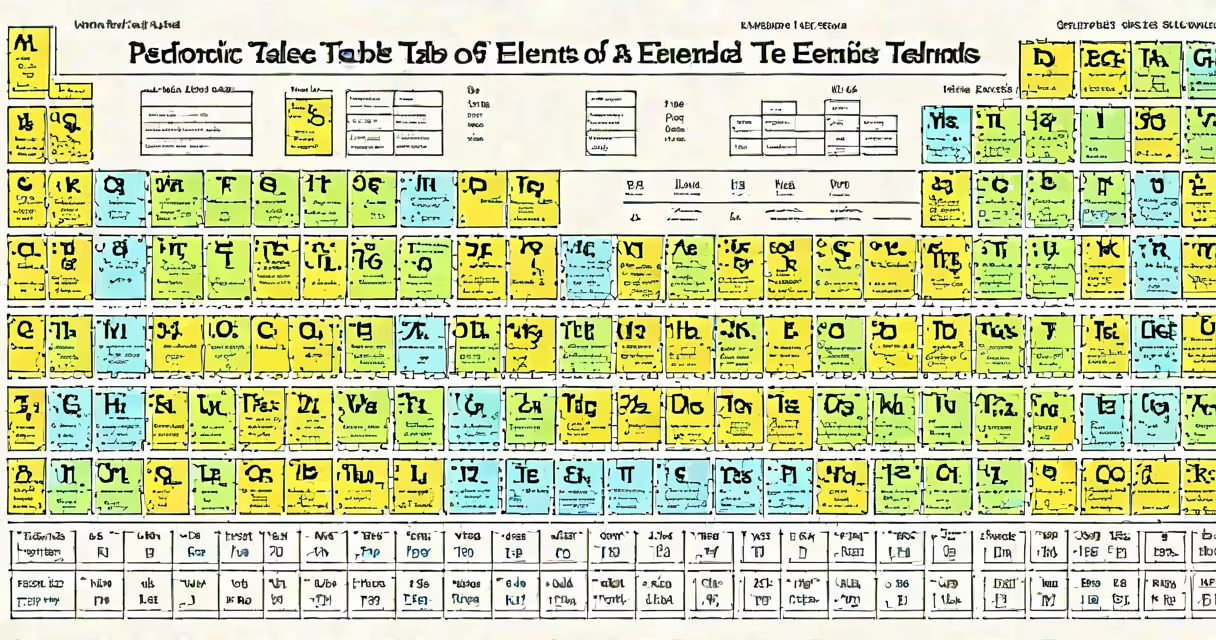
The periodic table of elements arranges all known chemical elements by increasing atomic number, organizing them into rows and columns that reveal patterns in their properties. This systematic layout helps chemists predict behaviors and relationships between elements.
Elements are arranged left to right by atomic number-the number of protons in their nucleus. Rows represent periods, while columns represent groups or families with similar properties. For example, all elements in Group 1 (alkali metals) have one electron in their outer shell, making them highly reactive.
The table's structure repeats periodically, meaning elements in the same group share characteristics. This periodicity arises from the way electrons fill energy levels around the nucleus. The table includes 118 confirmed elements, from hydrogen (atomic number 1) to oganesson (atomic number 118).
| Type | Examples | Properties |
|---|---|---|
| Metals | Iron, copper, gold | Shiny, conductive, malleable |
| Nonmetals | Carbon, oxygen, sulfur | Dull, brittle, poor conductors |
| Metalloids | Boron, silicon, germanium | Properties between metals and nonmetals |
| Halogens | Fluorine, chlorine, bromine | Highly reactive, form salts |
| Noble Gases | Helium, neon, argon | Inert, colorless, odorless |
Chemists use the periodic table to predict how elements will behave in reactions. For example, knowing that sodium (Na) is an alkali metal helps predict it will react vigorously with water. The table also helps identify new elements and understand their properties based on their position.
Teachers use it to explain atomic structure and bonding. Students learn that elements in the same group often form similar compounds. For instance, chlorine (Cl) and fluorine (F) both form -ide ions (Cl⁻ and F⁻) when reacting with metals.
Many people confuse the periodic table with a random list of elements. In reality, its design reveals deep patterns. For example, elements in the same period don't necessarily have similar properties, but elements in the same group do.
Another mistake is assuming all elements are stable. In fact, many heavy elements like plutonium (Pu) are radioactive and decay over time. The table includes synthetic elements created in labs, such as oganesson, which doesn't occur naturally.
When I taught chemistry, I used the periodic table to demonstrate why carbon (C) forms so many organic compounds. Its position in Group 14 allows it to bond with itself and other elements in various ways, creating everything. This practical example helped students grasp the table's predictive power.