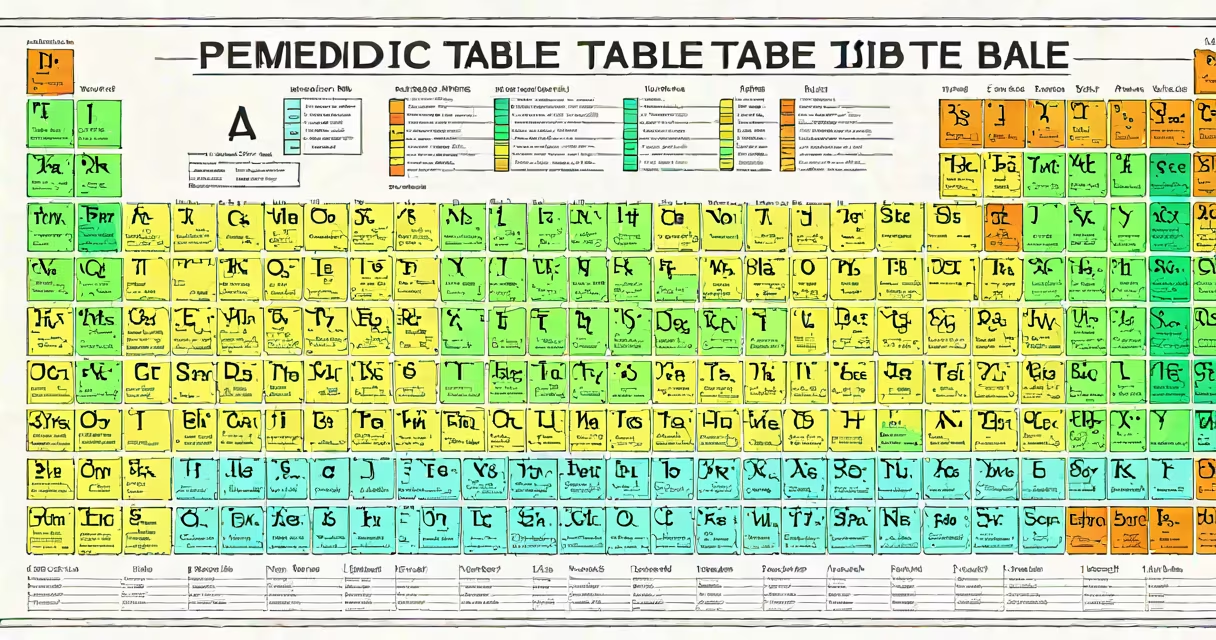
A periodic table with information is a chart displaying all known chemical elements arranged by increasing atomic number, along with their symbols, atomic weights, and other key properties. This structured layout reveals recurring patterns in element behavior.
The modern periodic table contains 118 confirmed elements, from hydrogen (atomic number 1) to oganesson (atomic number 118). Each element occupies a specific position based on its atomic number - the count of protons in its nucleus. The table's rows represent periods, while columns form groups with similar chemical properties.
Elements are organized in seven horizontal rows called periods and eighteen vertical columns called groups. Elements in the same group share similar chemical and physical properties due to having the same number of valence electrons - those in the outermost shell. For example, all Group 1 elements (alkali metals) have one valence electron and are highly reactive with water.
The table's structure reflects the periodic law, which states that element properties vary systematically according to their atomic number. This periodicity arises from the regular filling of electron shells as atomic numbers increase. The table's design allows scientists to predict the properties of newly discovered elements based on their neighbors' characteristics.
| Information Type | Example |
|---|---|
| Atomic Number | Number of protons in the nucleus (e.g., carbon has 6) |
| Element Symbol | One- or two-letter abbreviation (e.g., C for carbon) |
| Atomic Weight | Average mass of atoms (e.g., carbon weighs 12.011 atomic mass units) |
| Electron Configuration | Distribution of electrons in shells (e.g., [He] 2s² 2p² for carbon) |
| Group Number | Column position indicating chemical family (e.g., Group 14 for carbon) |
| Period Number | Row position indicating energy level (e.g., Period 2 for carbon) |
Chemists use the periodic table daily to understand element behavior, predict chemical reactions, and identify suitable materials for experiments. Teachers employ it to explain chemical concepts and demonstrate relationships between different elements. Students rely on it to memorize element properties and solve chemistry problems.
The table's predictive power extends beyond classroom use. Materials scientists develop new compounds by identifying elements with desired properties. Engineers select appropriate materials for construction projects based on element characteristics. Even medical professionals use the table to understand how elements interact in biological systems.
Many people confuse the periodic table with a mere list of elements. While it does contain all known elements, its true power lies in the relationships it reveals between them. The table's organization shows how elements with similar properties are grouped together, allowing scientists to make accurate predictions about undiscovered elements.
Another common mistake is assuming that elements are arranged by atomic weight rather than atomic number. Early versions of the table did use atomic weight, but Mendeleev's 1869 version and the modern table prioritize atomic number for better accuracy in predicting element properties.
When I first encountered the periodic table, I was struck by how much information it contained in such a compact format. I remember thinking it looked like a complex puzzle, but as I learned more about chemistry, I realized it was actually a useful tool for understanding the natural world.