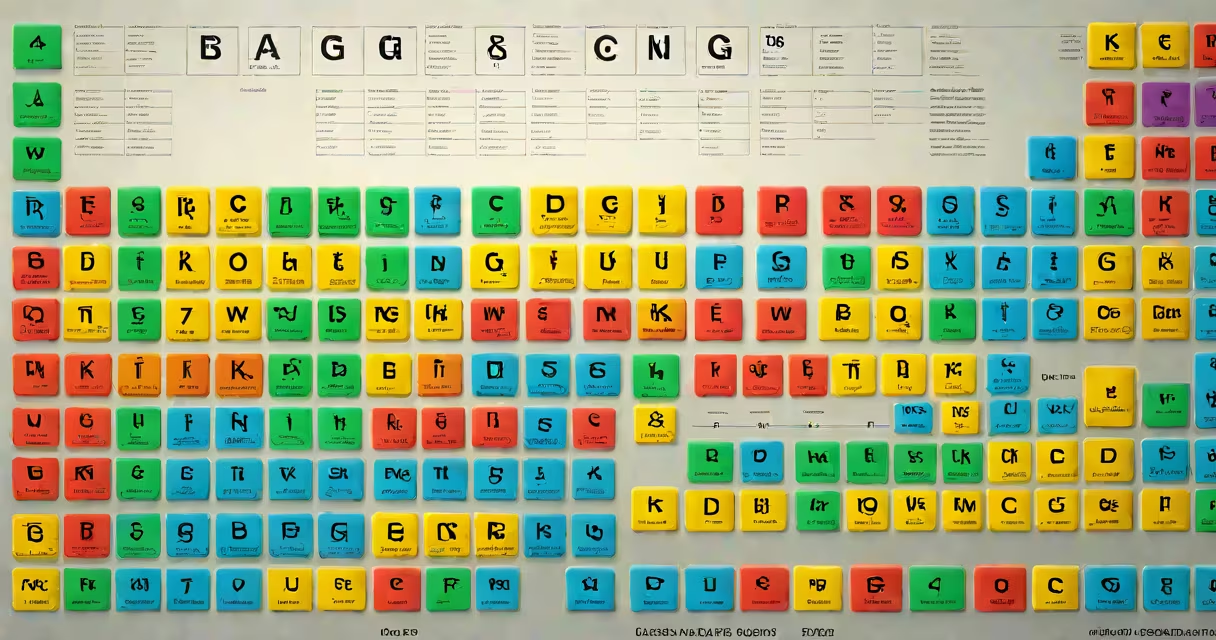
The periodic table is a systematic arrangement of chemical elements ordered by increasing atomic number, configured in rows and columns to display recurring patterns in their properties. This tabular layout reveals the periodic trends governing elements' behavior.
The table organizes elements into rows called periods and columns called groups. Each element is represented by its chemical symbol, atomic number, and atomic weight. Elements in the same group share similar properties, while elements in the same period have the same number of electron shells.
For example, hydrogen (H) at atomic number 1 shares properties with lithium (Li) at atomic number 3, both in Group 1. This pattern repeats across the table, allowing chemists to predict how elements will react.
The periodic table contains seven rows and 18 columns, with elements categorized into metals, metalloids, and nonmetals. Metals make up the majority, occupying the left and center of the table. Nonmetals are clustered to the upper right, while metalloids form a staircase-like line between them.
| Category | Location | Examples |
|---|---|---|
| Metals | Left and center | Iron (Fe), Copper (Cu) |
| Nonmetals | Upper right | Oxygen (O), Nitrogen (N) |
| Metalloids | Staircase line | Silicon (Si), Boron (B) |
Elements are also classified into blocks based on their electron configuration: s-block, p-block, d-block, and f-block. The lanthanides and actinides form two separate rows below the main table.
Many people confuse the periodic table with a mere list of elements. However, its true power lies in the patterns it reveals. For instance, the table predicts that elements in the same group will have similar chemical reactivity, a concept often misunderstood.
Another misconception is that the table is static. In reality, new elements are added as they are discovered or synthesized. The most recent additions are elements 113, 115, 117, and 118, officially recognized in 2016.
The periodic table is essential in various fields,. Chemists use it to understand chemical reactions, while engineers rely on it to develop new materials. For example, the development of semiconductors, important for modern electronics, was guided by the properties of elements in the periodic table.
In my experience, teaching the periodic table becomes more engaging when students see its practical applications. For instance, understanding how carbon (C) forms bonds with other elements helps explain the vast diversity of organic compounds, which are fundamental to life.
One common confusion is between atomic number and atomic weight. Atomic number represents the number of protons in an atom, while atomic weight is the average mass of an atom, including protons, neutrons, and electrons. For example, carbon has an atomic number of 6 and an atomic weight of approximately 12.011.
Another distinction is between elements and isotopes. Elements are defined by their atomic number, while isotopes are variants of an element with different numbers of neutrons. For instance, carbon-12 and carbon-14 are isotopes of carbon.
The periodic table is a fundamental tool in chemistry, providing a structured way to understand the properties and behaviors of elements. Its systematic arrangement reveals patterns that are important for predicting chemical reactions and developing new materials. By grasping the concepts behind the periodic table, one gains a deeper appreciation for the building blocks of the universe.