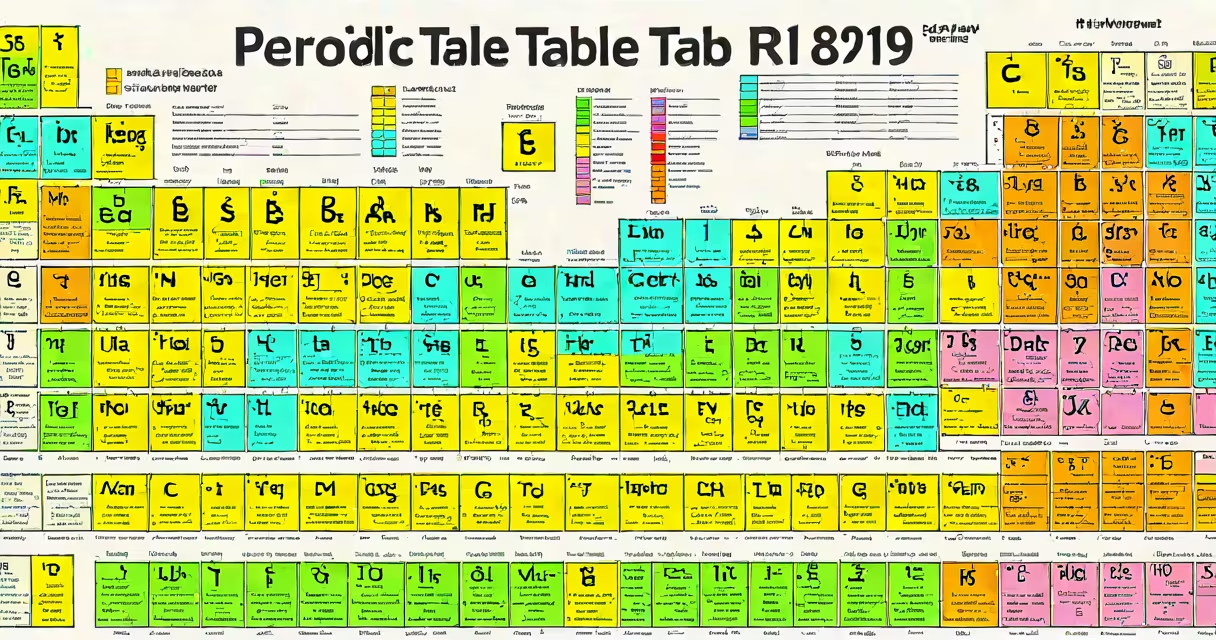
The periodic table arranges chemical elements by increasing atomic number, organizing them into rows and columns that reveal repeating patterns in their properties.
Elements are placed based on their atomic number-the number of protons in their nucleus. This arrangement exposes trends in electron configuration, which determines how elements behave chemically. For example, elements in the same column (group) share similar properties because they have the same number of electrons in their outer shell.
The table consists of 118 confirmed elements, divided into metals, metalloids, and nonmetals. Metals make up the majority, occupying the left and center of the table. The table has seven rows (periods) and 18 columns (groups).
| Group | Properties | Examples |
|---|---|---|
| Alkali Metals | Highly reactive, soft, low density | Lithium, Sodium |
| Halogens | Highly reactive, form salts with metals | Fluorine, Chlorine |
| Noble Gases | Inert, colorless, odorless gases | Helium, Neon |
Chemists use the periodic table to predict how elements will interact, design experiments, and develop new materials. It's also essential in education, providing a structure for understanding chemistry. For instance, scientists rely on the table to identify elements suitable for specific applications, such as using silicon in electronics due to its semiconducting properties.
Many people confuse the periodic table with a mere list of elements. However, it's a useful tool that reveals relationships between elements. Another misconception is that the table is static. In reality, new elements are added as they're discovered or synthesized, like the addition of elements 113, 115, 117, and 118 in 2016.
One non-obvious fact is that the table's design allows for the prediction of undiscovered elements. Dmitri Mendeleev, who created the table, left gaps for elements he believed existed but hadn't been found yet. His predictions were later confirmed with the discovery of gallium and germanium.
Consider carbon (C), atomic number 6. Located in group 14, it has four valence electrons, making it tetravalent. This property allows carbon to form stable bonds with other elements, forming the basis of organic chemistry. Carbon's position in the table helps chemists understand its ability to create long chains and complex molecules, which are fundamental to life.
I once used the periodic table to explain why water (H₂O) is a liquid at room temperature while hydrogen sulfide (H₂S) is a gas. The difference lies in their positions in group 16. Oxygen's higher electronegativity compared to sulfur leads to stronger hydrogen bonding in water, resulting in its liquid state.