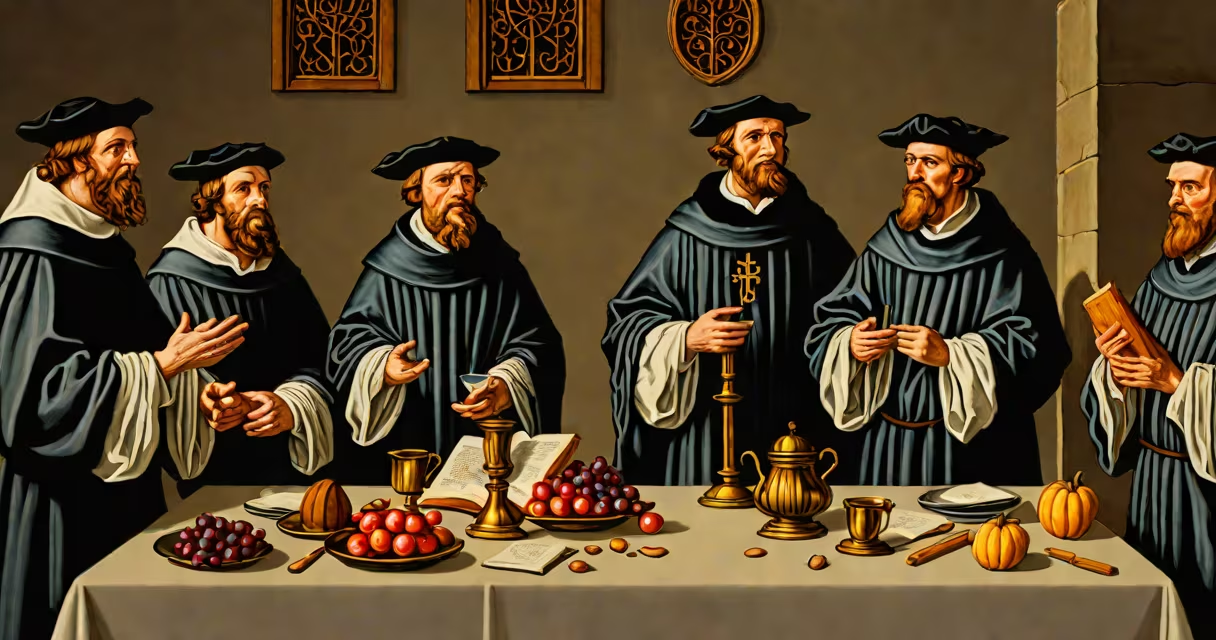
The five hosts were five key figures who emerged during the Protestant Reformation in the 16th century, shaping the theological and doctrinal foundations of Protestantism. These leaders challenged the authority of the Roman Catholic Church and proposed new interpretations of Christian doctrine.
The five hosts were Martin Luther, John Calvin, Ulrich Zwingli, John Knox, and Thomas Cranmer. Each played a key role in the Reformation, contributing to the development of Protestant theology and the establishment of Protestant churches across Europe.
| Host | Key Contribution |
|---|---|
| Martin Luther | Initiated the Reformation with his 95 Theses in 1517, emphasizing justification by faith alone. |
| John Calvin | Developed the system of theology known as Calvinism, outlined in his Institutes of the Christian Religion. |
| Ulrich Zwingli | Led the Reformation in Switzerland, advocating for the independence of the church from state control. |
| John Knox | Established the Presbyterian Church in Scotland, promoting the idea of a national church governed by elders. |
| Thomas Cranmer | Archbishop of Canterbury during the English Reformation, responsible for the Book of Common Prayer. |
The five hosts collectively challenged the religious and political structures of their time. Their teachings and actions led to the formation of various Protestant denominations, which continue to influence Christianity today. The Reformation principles they advocated, such as sola Scriptura (Scripture alone) and sola fide (faith alone), remain central to Protestant belief.
One common misconception is that the five hosts were unified in their beliefs. In reality, they had significant theological differences. For example, Luther and Zwingli disagreed on the nature of the Eucharist, with Luther maintaining a literal presence of Christ in the sacrament, while Zwingli viewed it as a symbolic act.
Visiting Wittenberg, Germany, where Martin Luther famously nailed his 95 Theses to the castle church door, provided a tangible connection to the Reformation. Standing in that historic location, the impact of the five hosts on the course of Christian history became vividly clear.
The legacy of the five hosts extends beyond the Reformation. Their writings and teachings continue to influence theological debates and the practices of Protestant churches worldwide. Understanding their contributions offers valuable insights into the development of Christian thought and the diverse traditions within Protestantism.