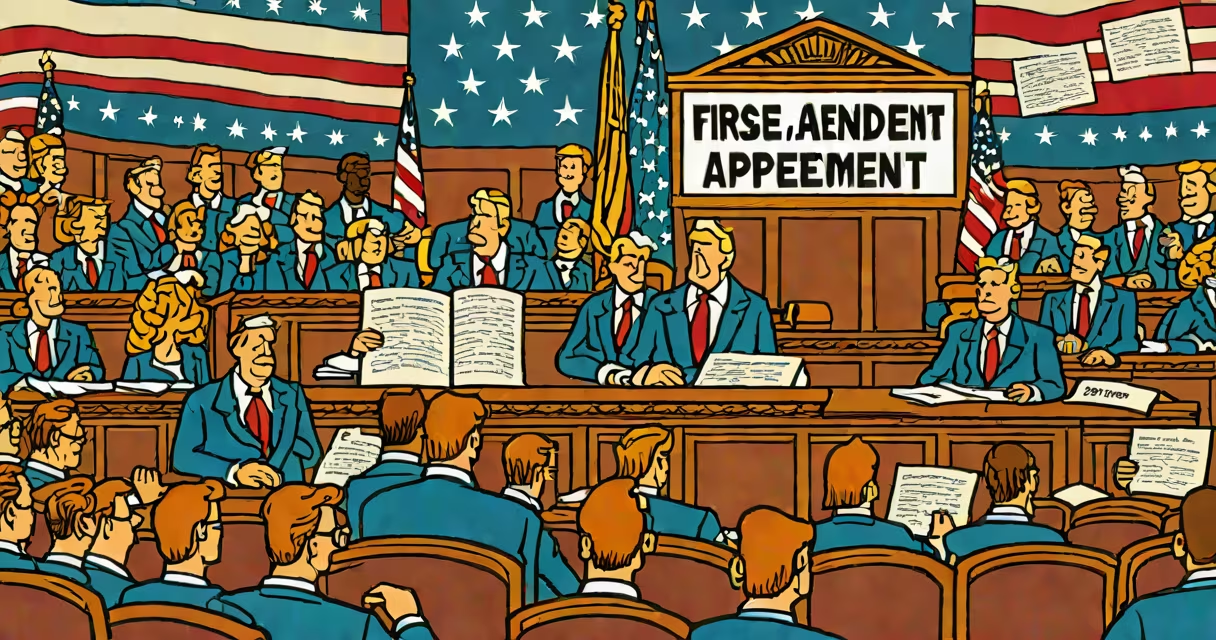
The First Amendment protects five fundamental freedoms: speech, religion, press, assembly, and petition. These protections apply to all levels of government and have shaped U.S. law since 1791.
The First Amendment restricts government actions that interfere with these freedoms. Courts balance these protections against other societal interests, such as public safety. The Supreme Court has ruled that these rights aren't absolute but must be narrowly tailored to avoid unnecessary restrictions.
The First Amendment includes five distinct protections:
Many people believe the First Amendment protects all speech absolutely. However, it doesn't protect defamation, incitement to violence, or threats. The government can restrict speech that creates a clear and present danger or involves fighting words likely to provoke violence.
Another misconception is that the First Amendment applies to private entities. It only restricts government actions, not those of businesses or individuals. For example, a private company can fire an employee for offensive speech, even if it's protected under the First Amendment.
In Tinker v. Des Moines (1969), the Supreme Court ruled that students had the right to wear black armbands to protest the Vietnam War. The court held that this symbolic speech was protected under the First Amendment, even though it occurred in a school setting. This case established that students retain their free speech rights in public schools unless the speech disrupts the educational environment.
For more details on the First Amendment, see our 5 facts about the First Amendment and 5 protections of the First Amendment. To understand its significance, read why the First Amendment is important.
| Protection | Limitations |
|---|---|
| Freedom of Speech | Does not protect defamation, obscenity, or incitement to violence |
| Freedom of Religion | Government can regulate religious practices that harm others (e.g., human sacrifices) |
| Freedom of the Press | Press can be restricted during wartime for national security reasons |
| Right to Assemble | Government can impose time, place, and manner restrictions for public safety |
| Right to Petition | Petitions must be lawful and cannot be used to harass or intimidate |
The First Amendment doesn't explicitly mention the internet, but courts have applied its protections to online speech. In Reno v. ACLU (1997), the Supreme Court ruled that the internet is a public forum deserving of First Amendment protections. This case struck down the Communications Decency Act, which attempted to regulate indecent material online.
Understanding the First Amendment requires recognizing its boundaries. While it safeguards fundamental freedoms, it doesn't provide unlimited protection. Knowing these limits helps citizens exercise their rights responsibly.