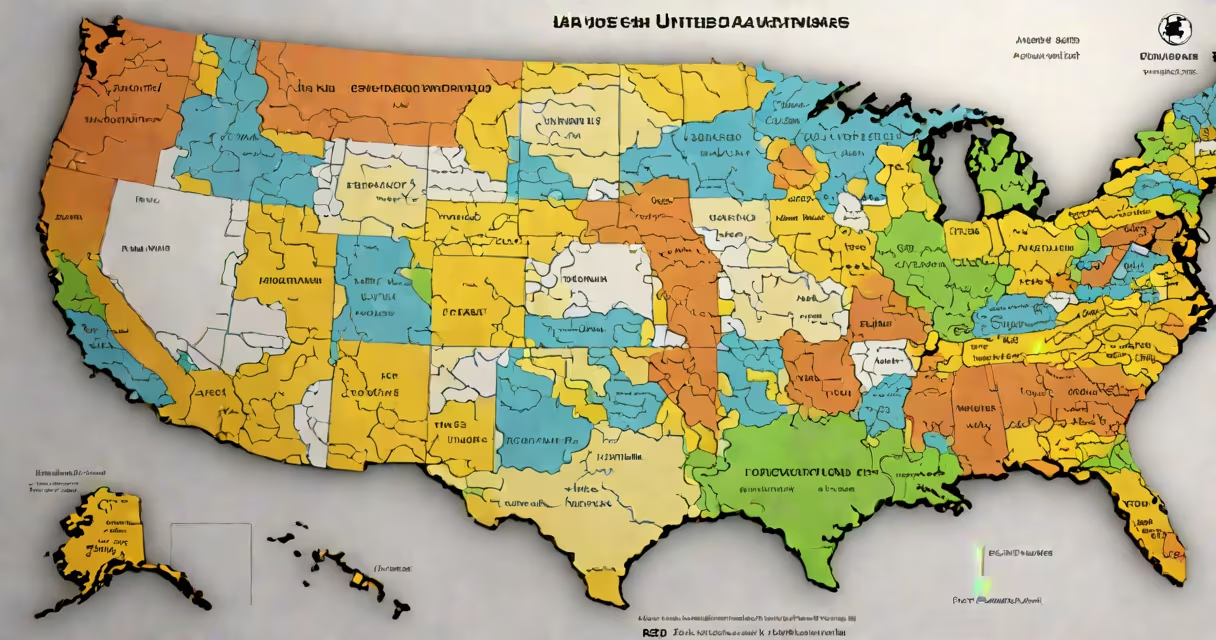
The United States USA is a federal republic consisting of 50 states, a federal district, five major territories, and various minor islands. It spans 3.8 million square miles across North America, bordered by Canada to the north, Mexico to the south, and the Atlantic and Pacific Oceans to the east and west.
Established in 1776 through the Declaration of Independence from British rule, the U.S. operates under a constitutional system with three branches of government: legislative, executive, and judicial. The capital is Washington, D.C., and the largest city is New York City.
The U.S. government functions as a federal republic, meaning power is shared between the national government and state governments. This system allows each state to maintain significant autonomy while contributing to the collective governance of the nation.
Key features include:
The United States includes several territories beyond its 50 states. These territories have varying levels of self-governance and representation in the federal government.
| Territory | Population | Status |
|---|---|---|
| Puerto Rico | 3.2 million | Unincorporated organized territory |
| Guam | 168,000 | Unincorporated organized territory |
| U.S. Virgin Islands | 106,000 | Unincorporated organized territory |
| American Samoa | 55,000 | Unincorporated unorganized territory |
| Northern Mariana Islands | 55,000 | Commonwealth in political union with the U.S. |
The United States is a global leader in various domains, including economics, military power, and cultural influence. Its economy is the largest in the world, driven by sectors such as technology, finance, and manufacturing.
The U.S. plays a significant role in international affairs, participating in organizations like the United Nations, NATO, and the World Trade Organization. It is also a major destination for immigrants, attracting people from around the world seeking opportunities and a better quality of life.
One common misconception is that all U.S. territories have the same status and rights as the 50 states. In reality, territories like Puerto Rico and Guam have different levels of self-governance and do not have voting representation in Congress.
Another misunderstanding is that the U.S. was always a single entity. In fact, it began as 13 colonies that declared independence from Britain and gradually expanded through treaties, purchases, and wars. For example, the Louisiana Purchase in 1803 doubled the size of the U.S. by acquiring land from France.
A lesser-known fact is that the U.S. has a unique system of state abbreviations. While most states use two-letter codes, such as CA for California and NY for New York, these abbreviations were standardized by the United States Postal Service in 1963. Before that, various abbreviations were used, leading to confusion. You can learn more about state abbreviations here.
The U.S. has a complex electoral system for presidential elections. The Electoral College, established by the Constitution, determines the president based on the number of electoral votes each state contributes. This system has been both praised and criticized for its impact on election outcomes.