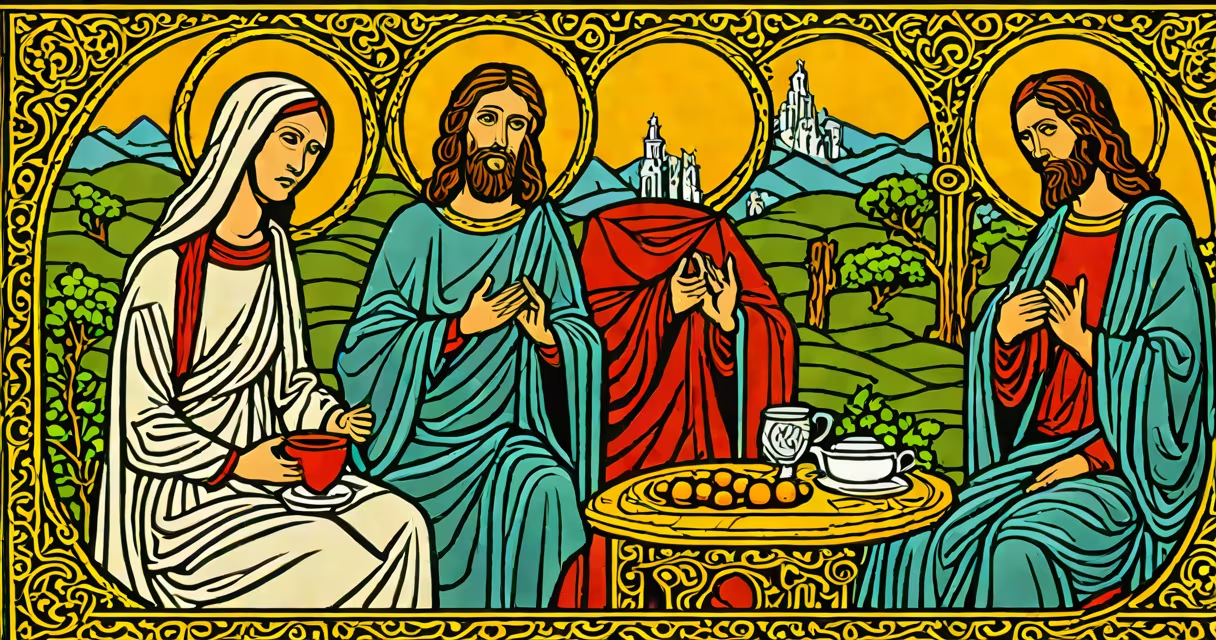
Jesus spoke directly to Mary Magdalene in the Gospels, recognizing her as a devoted follower and witness to his resurrection. These interactions reveal her unique role among his disciples.
The four Gospels record Jesus addressing Mary Magdalene by name twice: during his resurrection appearance in John 20:16 and when he cast out seven demons from her in Luke 8:2. While these are the only direct quotes attributed to Jesus about her, other passages describe her presence and actions.
In John 20:16, Jesus uses the Aramaic phrase "Rabboni" (meaning "teacher") when appearing to Mary after his resurrection. This intimate term suggests their close relationship. The Gospel of Luke (8:2) notes that Jesus healed Mary Magdalene by driving out seven demons, an act demonstrating his compassion and authority over evil forces.
Mary Magdalene appears in all four Gospels as a witness to Jesus' crucifixion, burial, and resurrection. Her prominence challenges the traditional view that only male disciples were central to Jesus' ministry. The Gospel of Mark (16:9) specifically identifies her as the first person to see the risen Christ, making her a key figure in early Christianity.
Scholars debate whether Mary Magdalene was a repentant sinner, as suggested by Luke 7:36-50, though this passage doesn't explicitly name her. The confusion likely arose from medieval traditions conflating her with other biblical women. The earliest Gospel accounts portray her primarily as a devoted disciple who supported Jesus financially (Luke 8:3).
Contrary to popular belief, the Bible doesn't describe Mary Magdalene as a prostitute. This misconception emerged in the 6th century when Pope Gregory I linked her with unnamed sinful women in the Gospels. Modern biblical scholarship separates these figures, emphasizing Mary's role as a faithful follower rather than a repentant sinner.
Another myth claims Jesus had a romantic relationship with Mary Magdalene, a theory popularized by Dan Brown's The Da Vinci Code. However, no credible historical or biblical evidence supports this idea. The Gospels present Mary as a respected disciple, not a romantic partner.
This passage provides the most detailed account of Jesus speaking to Mary Magdalene:
"But Mary stood weeping outside the tomb. As she wept, she bent over to look into the tomb; and she saw two angels in white, sitting where the body of Jesus had been lying, one at the head and the other at the feet. They said to her, 'Woman, why are you weeping?' She said to them, 'They have taken away my Lord, and I do not know where they have laid him.' When she had said this, she turned around and saw Jesus standing there, and did not know that it was Jesus. Jesus said to her, 'Woman, why are you weeping? Whom are you seeking?' Supposing him to be the gardener, she said to him, 'Sir, if you have carried him away, tell me where you have laid him, and I will take him away.' Jesus said to her, 'Mary!' She turned and said to him in Hebrew, 'Rabboni!' (which means Teacher). Jesus said to her, 'Do not hold on to me, because I have not yet ascended to the Father. But go to my brothers and say to them, 'I am ascending to my Father and your Father, to my God and your God.'" (NRSV)
This encounter underscores Mary's emotional connection to Jesus and her role as the first messenger of the resurrection. By addressing her by name, Jesus affirms her identity and mission.
Jesus' interactions with Mary Magdalene show the inclusive nature of his ministry. Unlike some Jewish leaders of the time, Jesus welcomed women as disciples and witnesses. Her presence at key moments-crucifixion, burial, and resurrection-validates women's roles in spreading the Christian message. This challenges historical interpretations that marginalized female disciples.
For modern readers, Mary Magdalene's story offers a model of faithfulness and resilience. Despite facing skepticism from other disciples (John 20:13), she remained steadfast in her devotion. Her example encourages contemporary believers to embrace discipleship fully, regardless of societal expectations.