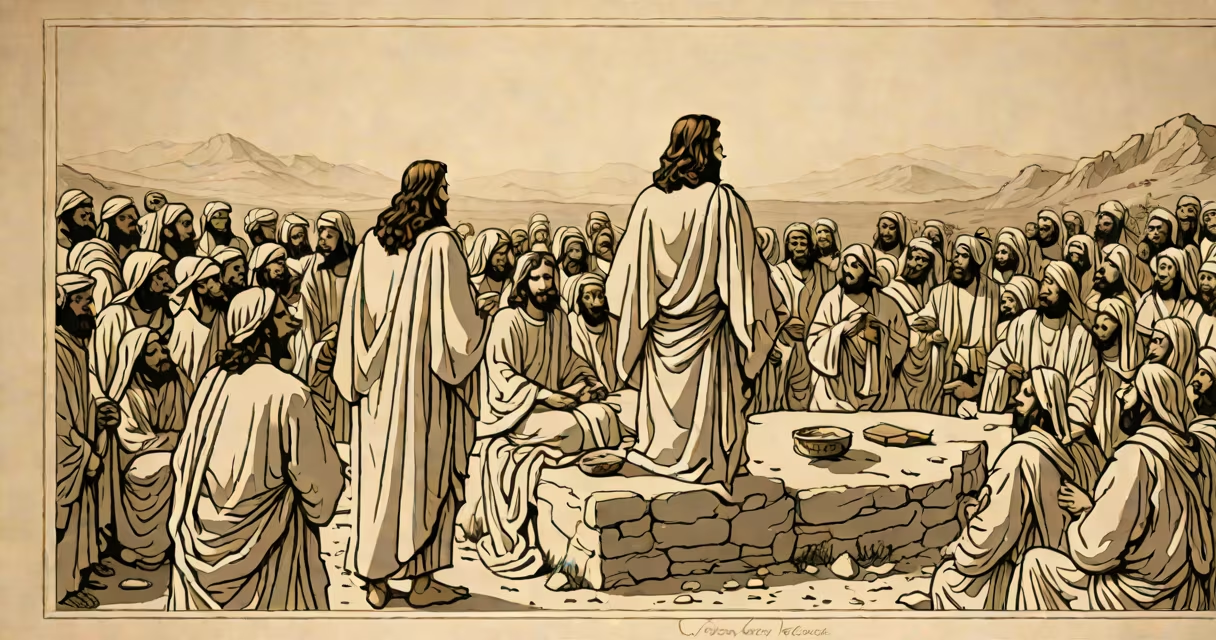
Jesus explicitly condemned violence as incompatible with God's kingdom, teaching his followers to love enemies and turn the other cheek. His most direct statements appear in the Gospels' conflict scenes and ethical teachings.
The Sermon on the Mount contains Jesus' clearest prohibitions against violent retaliation:
"You have heard that it was said, 'Eye for eye, and tooth for tooth.' But I tell you, do not resist an evil person. If someone strikes you on the right cheek, turn to him the other cheek also." (Matthew 5:38-39)
This passage rejects the Old Proof's lex talionis, replacing it with nonviolent resistance. Jesus' command to "love your enemies" (Matthew 5:44) extends this principle to those who actively harm believers.
Jesus faced violence throughout his ministry, particularly from religious authorities. His responses reveal his commitment to nonviolence:
These actions demonstrate that Jesus practiced what he preached about nonviolence.
Some argue Jesus' cleansing of the temple (Matthew 21:12-13) contradicts his peaceful teachings. However, this was symbolic protest against corruption, not violent aggression. The money changers' tables were overturned, but no people were harmed.
Others cite Jesus' statement about bringing "not peace, but a sword" (Matthew 10:34). This refers to family divisions caused by discipleship, not literal violence. The context shows Jesus prioritizing spiritual commitments over social harmony.
Jesus' teachings directly influenced early Christian practices. The Didache (c. 100 AD) instructs believers to "not return evil for evil" and to "love your enemies." Early church fathers like Tertullian and Origen consistently advocated pacifism based on Jesus' example.
However, some later Christian thinkers developed "just war" theories that departed from Jesus' explicit commands. These interpretations remain controversial among scholars and denominations.
Modern Christian movements like the Fellowship of Reconciliation and Christian Peacemaker Teams trace their roots to Jesus' teachings. They practice nonviolent resistance to oppression, following Jesus' example of turning the other cheek.
In my work with conflict mediation programs, I've seen how Jesus' teachings provide useful tools for resolving disputes without violence. When applied consistently, they create major alternatives to cycles of retaliation.