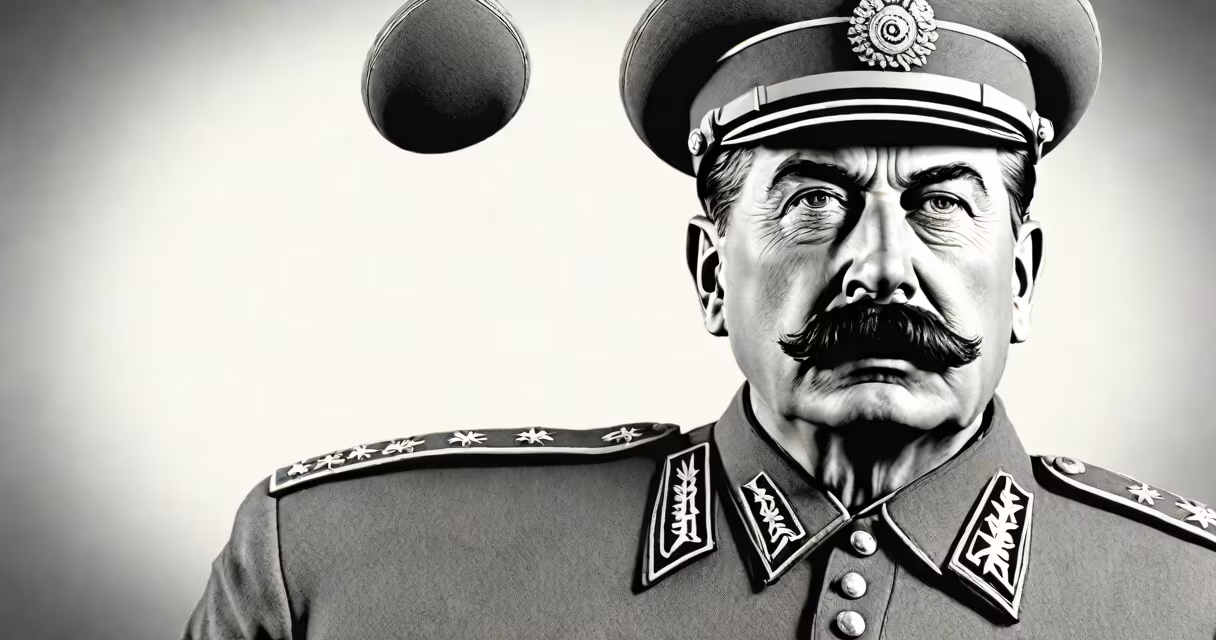
Joseph Stalin ruled the Soviet Union from 1924 until his death in 1953, implementing policies that killed millions through forced labor, famine, and executions while expanding Soviet influence during World War II.
After Lenin's death in 1924, Stalin outmaneuvered rivals like Leon Trotsky through political maneuvering and propaganda. By 1929, he had full control, using the Communist Party to enforce his rule. His secret police, the NKVD, eliminated opposition through purges, including the Great Purge of 1936-1938, which executed hundreds of thousands.
Stalin's rule was marked by rapid industrialization and collectivization. The latter forced peasants into state-run farms, leading to the 1932-1933 Holodomor famine in Ukraine, which killed an estimated 3.9 million people. He also launched five-year plans to modernize industry, often relying on slave labor from the Gulag system.
During World War II, Stalin allied with the U.S. and UK against Nazi Germany. After Germany invaded the USSR in 1941, Stalin's leadership helped turn the tide at battles like Stalingrad. Post-war, he expanded Soviet control over Eastern Europe, setting the stage for the Cold War. His actions in Korea and China also shaped global conflicts.
Stalin is often remembered as a ruthless dictator, but some Soviet-era propaganda portrayed him as a strong leader who industrialized the USSR. Historians now recognize his regime as one of the deadliest in history, with estimates of deaths under his rule ranging million. His legacy remains controversial, especially in Russia, where some still view him as a necessary figure.