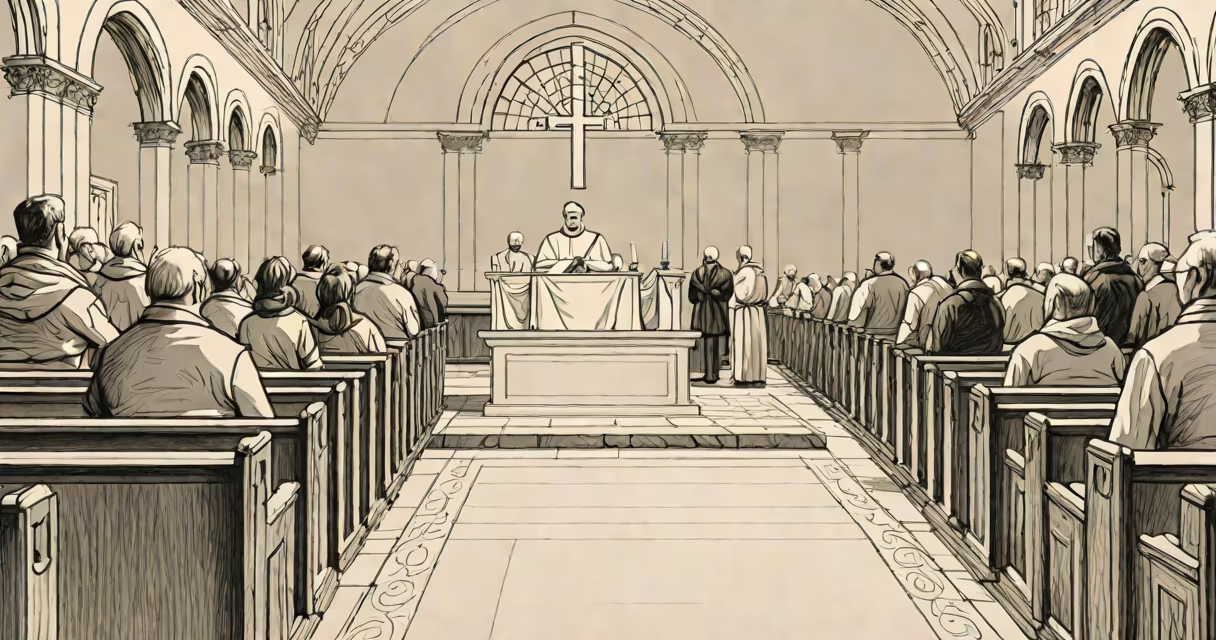
The Mass is the central act of worship in the Catholic Church, a sacred ritual where Catholics believe the bread and wine become the body and blood of Jesus Christ through transubstantiation.
The Mass follows a structured liturgy divided into two main parts: the Liturgy of the Word and the Liturgy of the Eucharist. The Liturgy of the Word includes readings from Scripture and a homily, while the Liturgy of the Eucharist involves the consecration of bread and wine, which Catholics believe becomes the real presence of Christ.
| Type | Description | When Celebrated |
|---|---|---|
| Sunday Mass | The most common Mass, celebrated every Sunday and Holy Day of Obligation | Every Sunday and major feast days |
| Daily Mass | A shorter version of the Sunday Mass, often celebrated on weekdays | Weekdays |
| Mass with Anointing of the Sick | A special Mass for those who are ill or dying, including the sacrament of Anointing of the Sick | As needed for the sick |
The Mass is the primary way Catholics fulfill their obligation to worship God on Sundays and Holy Days of Obligation. It is also a source of grace and spiritual nourishment, uniting Catholics in communion with Christ and each other.
Many people confuse the Mass with a mere memorial service or symbolic ritual. However, Catholics believe it is a re-presentation (not a re-enactment) of Christ's sacrifice on Calvary, making it a profound act of worship and communion with God.
Another misconception is that the Mass is only for Catholics. While the Mass is a Catholic ritual, many churches welcome non-Catholics to observe or participate in certain aspects, such as the Liturgy of the Word.
During a typical Sunday Mass, the priest begins with the Sign of the Cross, followed by the Liturgy of the Word, which includes readings from the Old and New Testaments, a psalm, and a Gospel reading. After the homily, the congregation recites the Creed and prayer of the faithful. The Liturgy of the Eucharist then begins with the presentation of bread and wine, followed by the Eucharistic Prayer, where the bread and wine are consecrated. The priest then distributes Communion to the congregation, who receive the body of Christ.
I attended a Sunday Mass at St. Peter's Basilica in Vatican City. The experience was profound, with the beautiful architecture and the solemnity of the ritual creating a sense of awe and reverence. The homily, delivered by a cardinal, focused on the importance of faith and charity in daily life, resonating deeply with the congregation.