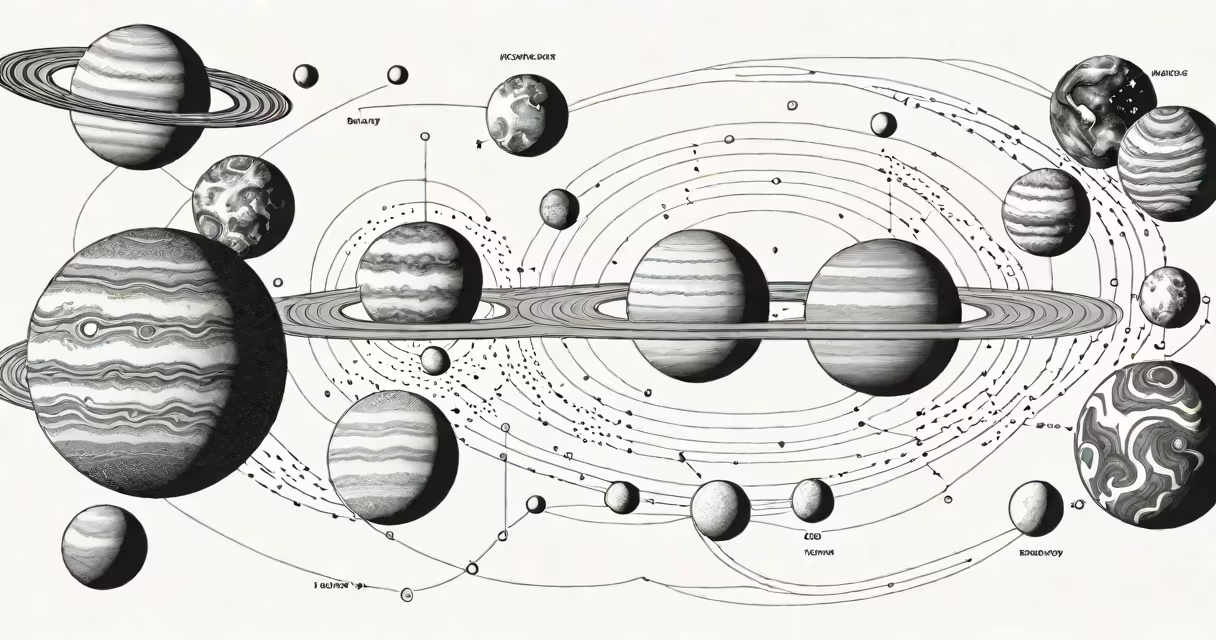
A planetary alignment occurs when planets in the solar system appear close together in the sky from Earth's perspective. These alignments happen when several planets share the same region of the sky, creating a visually striking pattern.
The planets in our solar system follow elliptical orbits around the Sun, all lying roughly in the same plane called the ecliptic. When viewed from Earth, planets appear to move along this ecliptic path. A planetary alignment happens when several planets cluster near the same point along this path.
Alignments can involve any number of planets, though most notable events feature at least three. The frequency varies depending on which planets are involved. For example, Mercury and Venus align with Jupiter about every 13 months, while alignments involving outer planets occur less frequently.
| Alignment Type | Frequency | Example |
|---|---|---|
| Mini-alignment | Monthly | Two planets close together |
| Triple conjunction | Every few years | Three planets within 5 degrees |
| Grand alignment | Once per decade | Five or more planets visible |
Planetary alignments result from the relative positions of planets in their orbits. Since all planets orbit the Sun in the same direction, they occasionally bunch up on the same side of the Sun from our viewpoint. This creates the appearance of alignment when viewed from Earth.
A common misconception is that planetary alignments cause gravitational effects on Earth. In reality, the gravitational influence of these distant planets is negligible compared to the Moon's effect on tides. NASA confirms that planetary alignments have no significant impact on Earth's rotation or tectonic activity.
One of the most famous planetary alignments occurred in June 2000, when five planets (Mercury, Venus, Mars, Jupiter, and Saturn) appeared in a straight line. Another significant event happened in May 2011, when Mercury, Venus, Mars, Jupiter, and Saturn were visible together before sunrise.
In my experience observing the night sky, the most impressive alignment I witnessed was in August 2016, when Jupiter, Venus, and the crescent Moon formed a tight triangle visible to the naked eye. This event drew many amateur astronomers outdoors to witness the spectacle.
Many confuse planetary alignments with other astronomical phenomena. Unlike meteor showers or eclipses, planetary alignments don't involve objects passing in front of each other. Instead, they create patterns in the sky that can be seen with the naked eye or through binoculars.
To view planetary alignments, check astronomy websites for upcoming events. Most alignments are visible before sunrise or after sunset when the sky is darkest. Use a star chart or astronomy app to locate the planets in the sky.
While some alignments require telescopes, many are visible to the naked eye. For the best viewing experience, find a location away from city lights with an unobstructed view of the horizon.