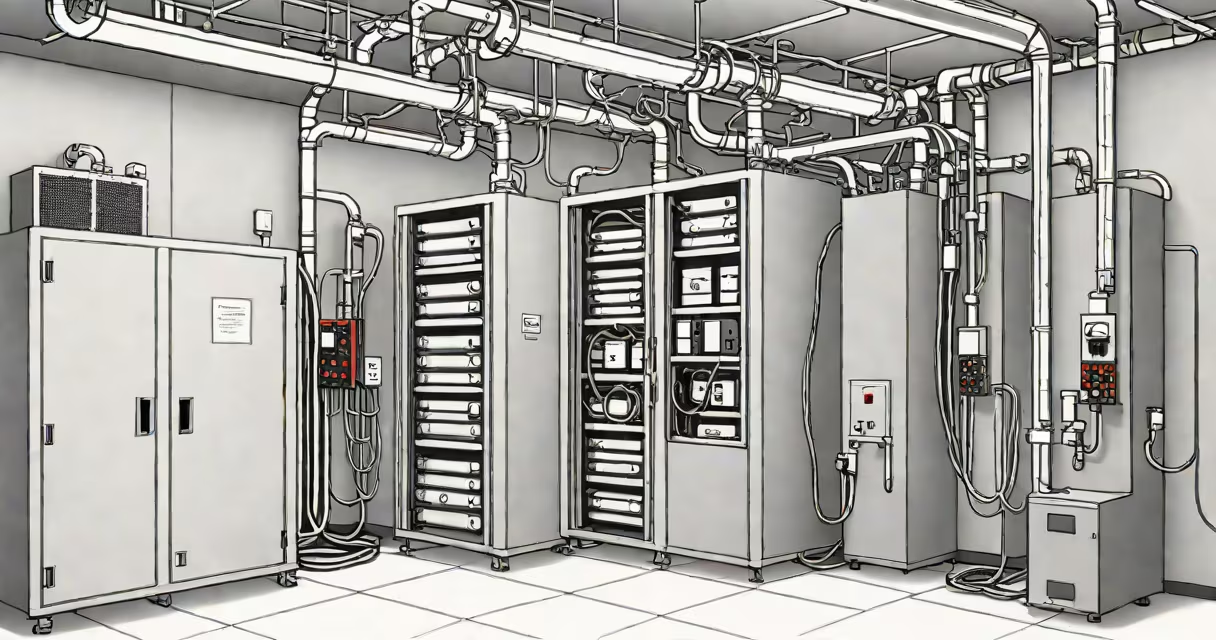
A clean agent is a fire suppression chemical that extinguishes flames without leaving residue on equipment or surfaces. These gaseous agents are electrically non-conductive, making them ideal for protecting sensitive environments.
Clean agents interrupt the combustion process by absorbing heat or chemically disrupting the flame. They remain in gas form at atmospheric pressure, dispersing evenly throughout a protected space. Most systems discharge within 10 seconds, faster than traditional methods.
For example, FM-200 (heptafluoropropane) discharges at 38 degrees Celsius (100 degrees Fahrenheit), expanding to fill a room while cooling the area enough to suppress flames. The agent then dissipates harmlessly into the atmosphere.
| Agent | Chemical Formula | Boiling Point (°C) | Typical Applications |
|---|---|---|---|
| FM-200 | C₃HF₇ | -14 | Data centers, telecom facilities |
| Novec 1230 | C₆F₁₂O | 49 | Archival storage, museums |
| CO₂ | CO₂ | -78.5 | General industrial protection |
Clean agents protect areas containing valuable electronics, archives, or people:
These systems are common in facilities where water or foam would cause damage. For instance, the Library of Congress uses clean agents to protect its rare book collections from fire without risking water damage to delicate materials.
Many assume clean agents are toxic or harmful to the environment. While early halon-based agents were ozone-depleting, modern clean agents like FM-200 and Novec 1230 have negligible environmental impact and are safe for occupied spaces when used as directed.
Another myth is that clean agents are only for large facilities. Systems scale down to protect small server closets or even individual pieces of equipment.
These systems use a network of sensors to detect heat or smoke. When triggered, they release the agent from cylinders mounted above the protected area. The agent flows through piping to nozzles distributed throughout the space.
During an installation I observed, technicians calculated the exact amount of agent needed based on the room's volume and contents. They positioned nozzles to ensure complete coverage, including dead zones behind equipment racks.
Most systems include an alarm to warn occupants before discharge. After activation, ventilation clears the agent, allowing safe re-entry typically within minutes.