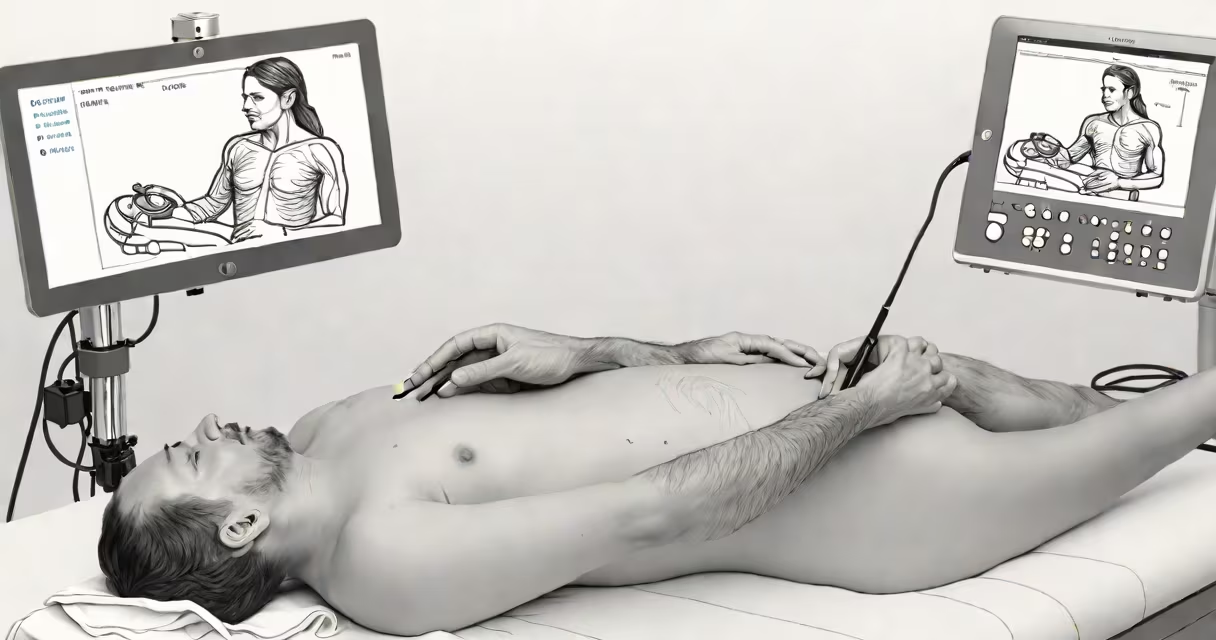
An abdominal ultrasound scan is a diagnostic imaging test that uses high-frequency sound waves to create live images of organs and other structures inside your upper abdomen. These images help doctors assess and diagnose conditions affecting the liver, pancreas, spleen, kidneys, gallbladder, and other abdominal organs.
During the procedure, a technician applies a special gel to your skin and moves a handheld device called a transducer over your abdomen. The transducer emits sound waves that bounce off internal structures and return as echoes. A computer converts these echoes into real-time images displayed on a monitor.
The entire process typically takes 30 to 60 minutes. Unlike X-rays or CT scans, ultrasounds don't use ionizing radiation, making them safer for repeated use.
| Type | Focus Area | Common Uses |
|---|---|---|
| Routine abdominal ultrasound | General view of abdominal organs | Initial assessment of abdominal pain or unexplained weight loss |
| Doppler ultrasound | Blood flow in abdominal vessels | Evaluating blood flow issues in organs like the liver or kidneys |
| Endoscopic ultrasound | Digestive tract and surrounding tissues | Examining the pancreas, bile ducts, or stomach lining |
Doctors order abdominal ultrasounds to investigate symptoms like abdominal pain, swelling, or unexplained weight loss. They're also used to monitor known conditions such as liver disease, kidney failure, or tumors. Unlike CT scans, ultrasounds provide real-time imaging, which is useful for guiding procedures like biopsies.
For example, an abdominal ultrasound can detect gallstones, which are hard deposits that form in the gallbladder. According to the American College of Gastroenterology, gallstones affect about 10-15% of adults in the U.S., making this a common reason for the scan.
Many people confuse abdominal ultrasounds with other imaging tests like CT scans or MRIs. While all these methods produce images of internal structures, ultrasounds are unique because they use sound waves instead of radiation or magnetic fields. This makes them safer for pregnant women and children.
Another misconception is that ultrasounds are only used during pregnancy. While obstetric ultrasounds are well-known, abdominal ultrasounds play a critical role in diagnosing many non-pregnancy-related conditions.
I once accompanied a friend to their abdominal ultrasound appointment. The technician explained that the procedure was painless and non-invasive. My friend lay on their back while the technician moved the transducer over their abdomen. The images appeared instantly on the screen, showing the liver, kidneys, and other organs. The doctor later used these images to diagnose a small kidney stone, allowing for prompt treatment.
Abdominal ultrasounds are a valuable tool in medical diagnostics, offering a safe, effective way to visualize internal organs and guide treatment decisions.