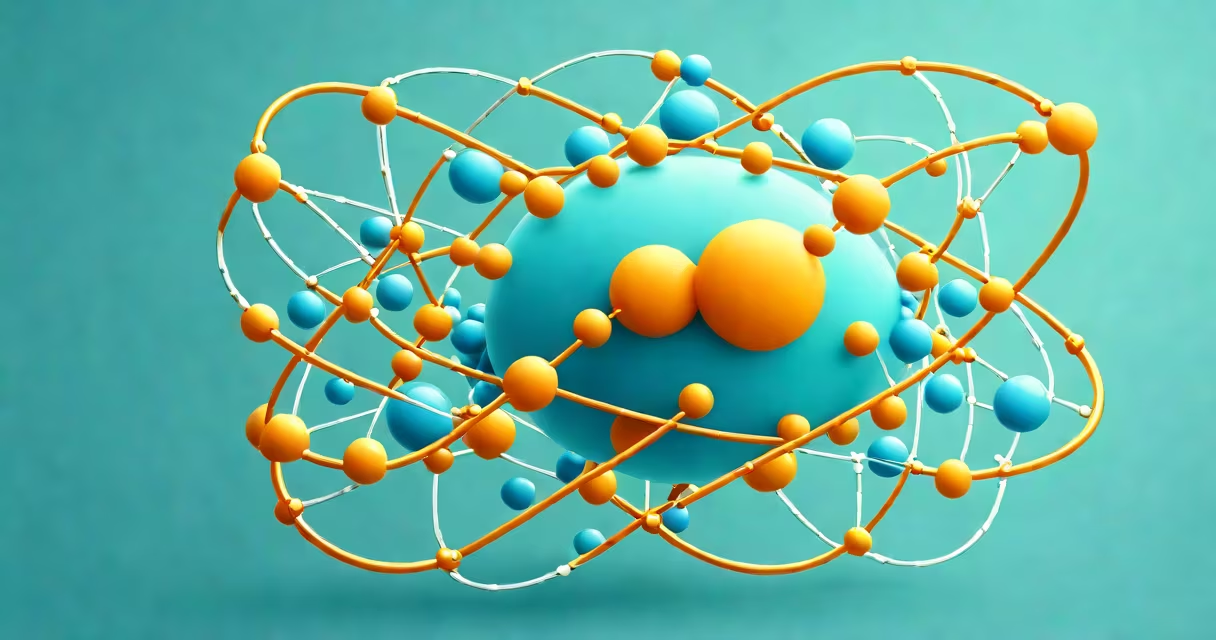
Atomic structure in chemistry refers to the arrangement of particles within an atom: protons and neutrons in the nucleus, surrounded by electrons in orbitals. This organization determines an element's properties.
Every atom consists of three subatomic particles: protons (positively charged), neutrons (neutral), and electrons (negatively charged). The nucleus contains protons and neutrons, while electrons orbit around it in energy levels called shells.
The three primary components are:
Atomic structure explains how elements interact. Electrons in the outermost shell (valence electrons) dictate bonding behavior. For example, oxygen (8 protons) typically gains 2 electrons to achieve stability, forming compounds like water (H2O).
Chemists use this knowledge to predict reactions. Sodium (11 protons) readily loses its outer electron, bonding with chlorine (17 protons) to form table salt (NaCl).
Many assume atoms are solid spheres. In reality, they are mostly empty space. The nucleus occupies just 0.00000001% of an atom's volume, with electrons scattered in a diffuse cloud.
Another myth is that electrons orbit like planets. Electrons exist in probability clouds (orbitals), not fixed paths. Quantum mechanics describes their likely positions rather than exact locations.
When I built a simple model of a lithium atom (3 protons, 4 neutrons, 3 electrons) in a lab, I placed two electrons in the inner shell and one in the outer. This configuration explained why lithium readily donates its outer electron to form bonds.
Understanding atomic structure helps chemists design new materials. Graphene, for instance, derives its strength from carbon atoms arranged in a hexagonal lattice, with each carbon forming three strong bonds.