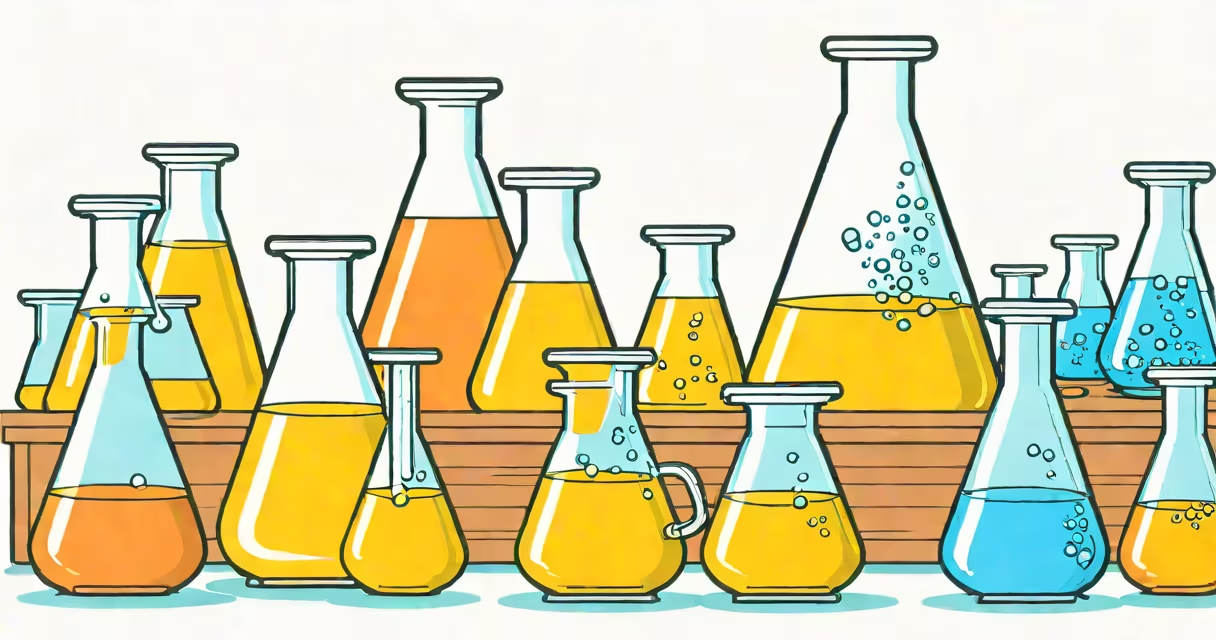
A concentrated solution contains a large amount of dissolved substance (solute) relative to the solvent. For example, a 10% sodium chloride solution has 10 grams of salt dissolved in 100 milliliters of water.
Concentration measures how much solute dissolves in a given volume or mass of solvent. Common units include molarity (moles per liter), molality (moles per kilogram), and percent composition (grams per 100 grams). A solution with higher solute-to-solvent ratio is more concentrated.
Solutions reach saturation when no more solute can dissolve at a given temperature. For instance, sugar in water becomes saturated at about 200 grams per 100 milliliters at room temperature. Beyond this point, excess solute precipitates out.
| Type | Example | Common Use |
|---|---|---|
| High-molarity solutions | 12 M hydrochloric acid | Laboratory cleaning |
| Hypertonic solutions | Saline solutions with higher osmolarity than blood plasma | Medical treatments requiring fluid removal |
| Supersaturated solutions | Carbonated beverages | Beverage industry |
Concentrated solutions appear in various fields due to their properties. In laboratories, concentrated acids like sulfuric acid (H₂SO₄) are used for cleaning and chemical reactions. The food industry employs concentrated fruit juices to preserve flavor while reducing volume during transport.
In medicine, hypertonic saline solutions draw fluid out of cells through osmosis, treating conditions like cerebral edema. However, improper handling can cause burns or toxicity, necessitating careful dilution before use.
Many confuse concentrated solutions with supersaturated ones. While both have high solute levels, supersaturated solutions contain more solute than normally possible at a given temperature, achieved through heating or pressure changes. For example, a supersaturated solution of sodium acetate forms when heated, then crystallizes upon cooling.
Another mistake is assuming all concentrated solutions are dangerous. While some, like concentrated sulfuric acid, are corrosive, others like concentrated orange juice are safe for consumption. Always check material safety data sheets (MSDS) for proper handling guidelines.
I once prepared a concentrated buffer solution for a lab experiment. By dissolving 48.4 grams of Tris base in 500 milliliters of water, I created an 0.4 M solution. This high concentration ensured stable pH levels during protein extraction, demonstrating the practical applications of concentrated solutions in research settings.