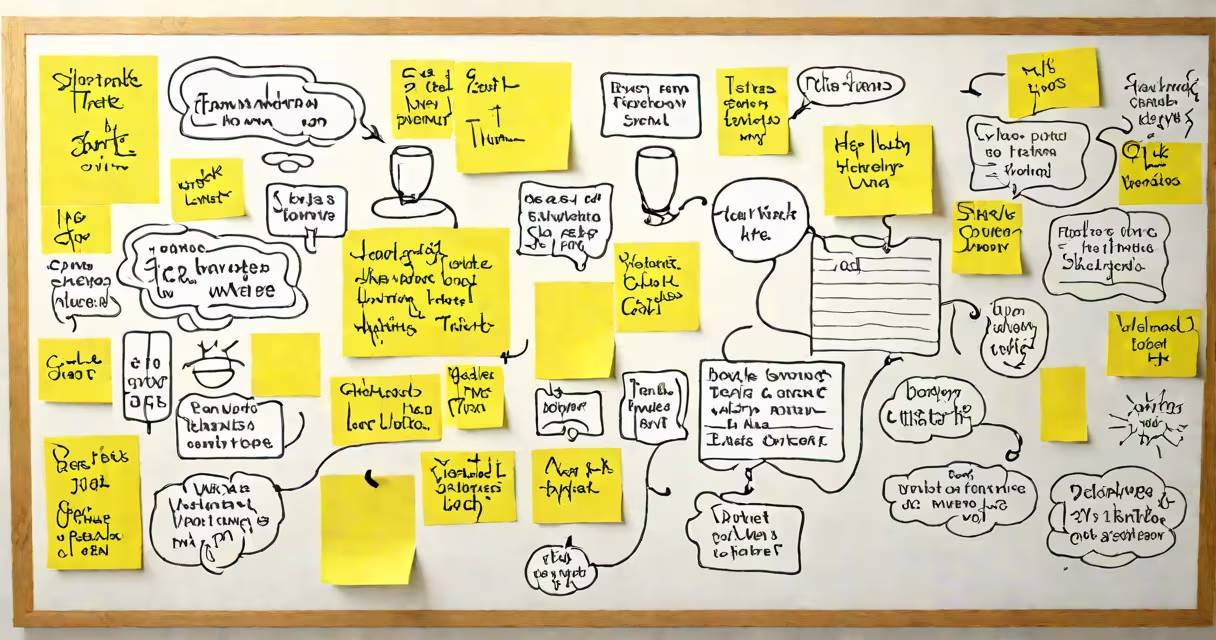
Divergent thinking is a problem-solving technique that explores many possible solutions by breaking away from conventional or obvious paths. It prioritizes quantity and variety of ideas over quality or correctness.
Divergent thinking encourages free association and unconventional connections. Instead of narrowing options early, it delays judgment to maximize creative output. The process often follows four stages:
Divergent thinking includes several techniques:
| Technique | Description |
|---|---|
| Brainstorming | Group or individual sessions to generate ideas quickly. |
| Mind Mapping | Visual diagrams that organize information around a central concept. |
| SCAMPER | Asking questions like Substitute, Combine, Adapt, Modify, Put to another use, Eliminate, and Reverse to spark ideas. |
| Random Stimuli | td>Using random words or images to trigger unexpected associations.
Many confuse divergent thinking with linear thinking, which follows a step-by-step logical progression. Unlike linear thinking, divergent thinking embraces ambiguity and open-ended exploration. Another misconception is that divergent thinking ignores structure entirely. In reality, it uses structured techniques like brainstorming to guide creativity.
For instance, a team designing a new app might start with divergent thinking to generate hundreds of features. Later, they'd use convergent thinking to narrow them down to the most practical ones. This balance ensures both creativity and feasibility.
I've used divergent thinking in workshops where participants struggled to think outside the box. By encouraging wild ideas first, we uncovered new solutions they'd initially dismiss as impractical.
J.P. Guilford introduced divergent thinking in 1956 as part of his theory of intelligence. He distinguished it from convergent thinking, which focuses on finding a single correct solution. Research shows that divergent thinking boosts creativity and problem-solving in education and business.
For example, a study by Runco and Richards (1998) found that individuals with high divergent thinking scores produced more original ideas in creative tasks. Companies like Google and Apple integrate divergent thinking into their innovation processes to build breakthrough ideas.
Divergent thinking is a useful tool for generating creative solutions by exploring multiple possibilities. Whether in business, education, or personal development, it helps overcome mental blocks and discover novel approaches. By combining it with convergent thinking, teams can balance creativity with practicality for effective problem-solving.