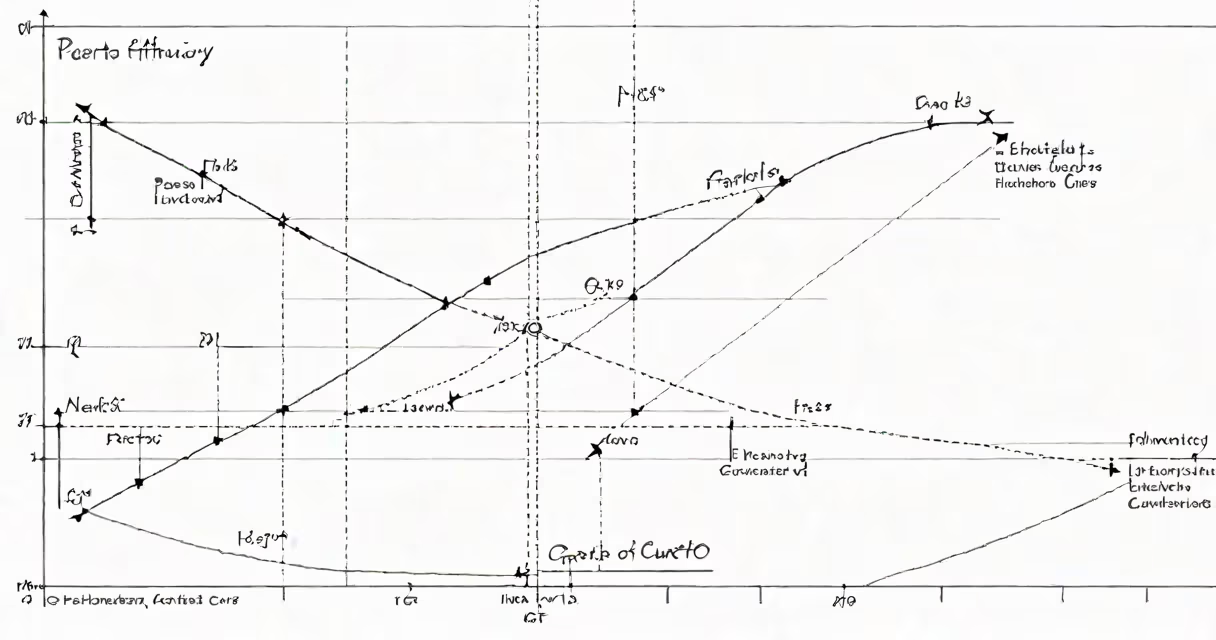
Pareto efficiency occurs when resources are allocated in a way that makes no one better off without making someone else worse off. Named after economist Vilfredo Pareto, this concept measures economic efficiency by evaluating whether changes improve at least one person's situation without harming others.
Pareto efficiency doesn't imply fairness or equality-just optimal resource use given existing conditions. For example, if redistributing wealth from Person A to Person B improves B's well-being but harms A, the original state was Pareto efficient. Economists use this principle to analyze market outcomes, policy changes, and social welfare.
A state is Pareto efficient if no further changes can benefit one party without negatively affecting another. This doesn't mean the current state is ideal-just that no better alternative exists under given constraints. Economists often visualize this using indifference curves, which map preferences between two goods. Any point along the curve represents a Pareto-efficient allocation.
For instance, imagine two people trading apples and oranges. If they swap until neither can improve their situation without the other losing out, they've reached Pareto efficiency. This concept applies broadly, from international trade agreements to healthcare resource allocation.
| Type | Description | Example |
|---|---|---|
| Allocative Efficiency | Resources are distributed so consumers value them equally across uses. | If everyone values a dollar equally, no further reallocation improves welfare. |
| Productive Efficiency | Resources are used in the most cost-effective way to maximize output. | A factory producing goods at the lowest possible cost per unit. |
Another misconception is that Pareto efficiency implies no room for improvement. In reality, it identifies inefficiencies where changes could benefit some without harming others. For example, if a tax cut boosts disposable income for some households without reducing public services, it moves society toward Pareto efficiency.
Pareto efficiency informs policy decisions, business strategies, and even personal finance. Governments use it to evaluate tax policies, healthcare funding, and infrastructure projects. Businesses apply it to improve production and pricing. Individuals rely on it when balancing budgets or negotiating trades.
One practical application is in environmental policy. If a pollution-reducing technology benefits the environment without increasing costs for businesses, it's a Pareto improvement. Economists use such examples to argue for policies that improve efficiency while maintaining or improving welfare.
While useful, Pareto efficiency has limitations. It assumes no changes can make someone better off without harming others, which may not account for long-term benefits or externalities. For example, investing in education improves future productivity but may require short-term sacrifices., Pareto efficiency doesn't address initial distributions of wealth or resources, which can lead to unfair outcomes despite efficiency.
To overcome these limitations, economists combine Pareto efficiency with other tools, such as cost-benefit analysis and equity considerations. This ensures policies and decisions balance efficiency with fairness and long-term sustainability.