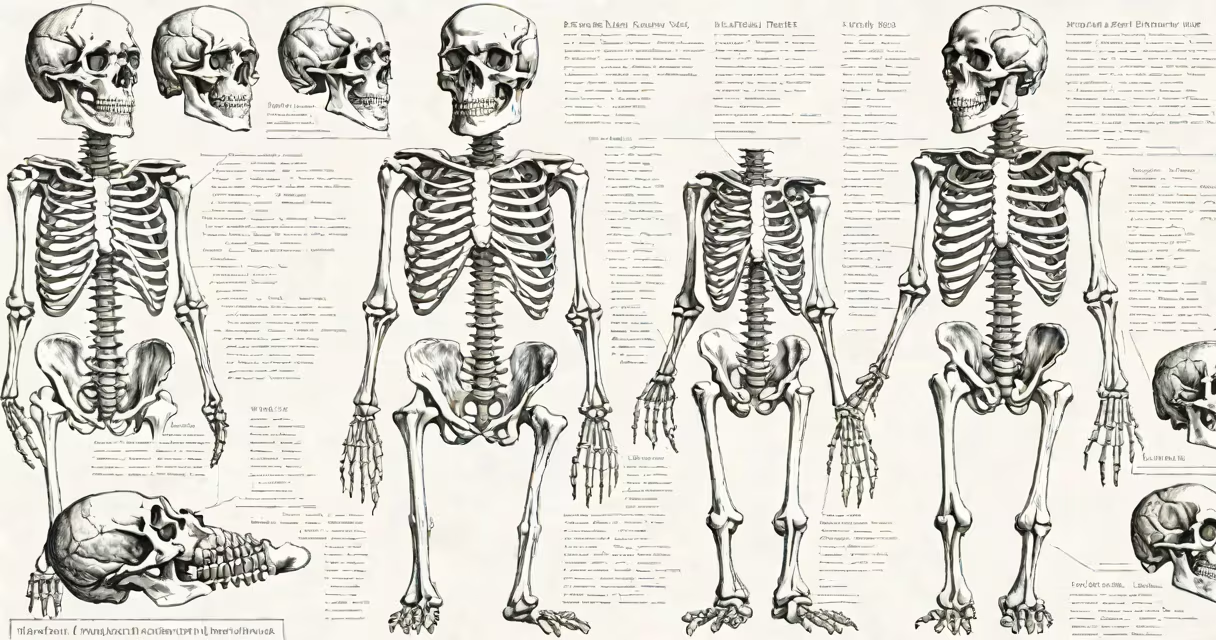
A skeleton is made of bones, cartilage, and connective tissues that form the structural structure of a body. In humans, this system supports movement, protects organs, and produces blood cells.
Bones are complex living tissues composed primarily of minerals, proteins, and water. The primary mineral is calcium phosphate, which gives bones their hardness. Collagen, a fibrous protein, provides flexibility and tensile strength.
Human skeletons contain several types of bones, each serving distinct functions:
| Type | Description | Examples |
|---|---|---|
| Long Bones | Longer than they are wide, designed for support and movement | Femur, humerus |
| Short Bones | Cube-shaped, provide stability and support | Wrist and ankle bones |
| Flat Bones | Thin and flat, protect organs and provide surface area for muscle attachment | Ribs, shoulder blades |
| Irregular Bones | Various shapes, fit complex functions | Vertebrae, hip bones |
Cartilage, a flexible connective tissue, cushions joints and provides structure where bones meet. It is found in the ears, nose, and between vertebrae. Ligaments and tendons connect bones to other bones and muscles, ensuring stability and movement.
The skeletal system performs several critical functions beyond structural support. It protects important organs like the heart and lungs, produces red and white blood cells in bone marrow, and stores minerals such as calcium and phosphorus.
For instance, the rib cage protects the heart and lungs, while the skull safeguards the brain. Bones also act as a reservoir for minerals, releasing them into the bloodstream as needed.
Many people believe bones are inert structures, but they are changing tissues that constantly remodel. Osteoclasts break down old bone, while osteoblasts build new bone, a process essential for growth and repair.
Another misconception is that bone density remains constant. In reality, it peaks around age 30 and gradually declines if not maintained through exercise and proper nutrition.
During a visit to a medical museum, I observed the complex structure of bones under a microscope. The layers of compact and spongy bone were visible, highlighting the complexity often overlooked in everyday life.