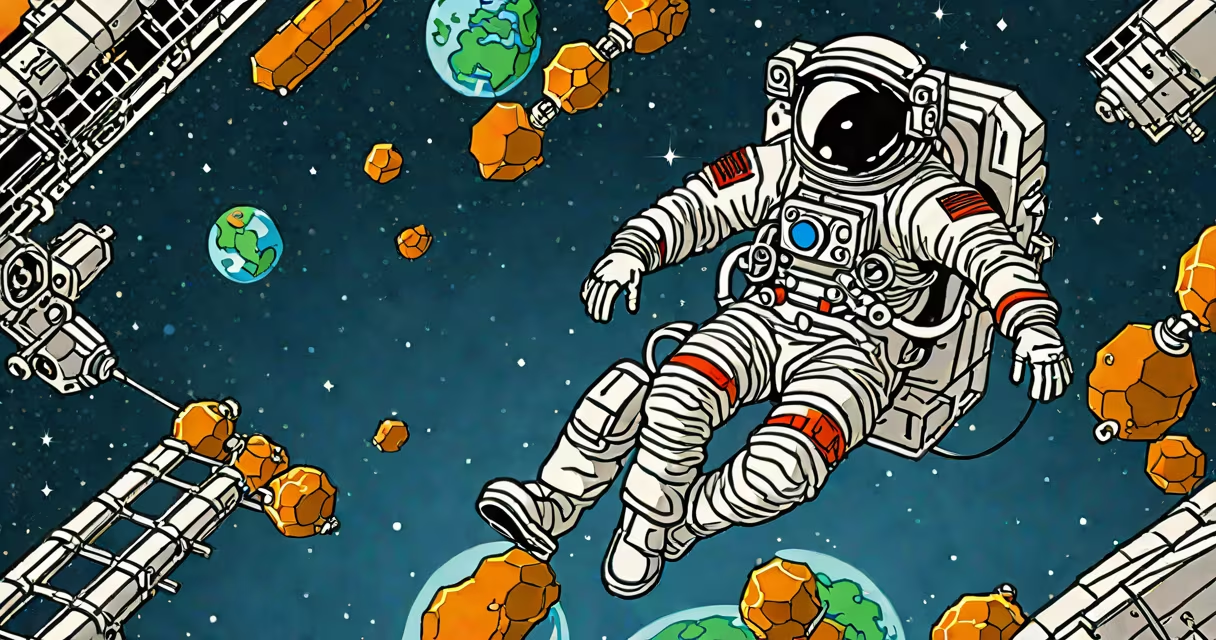
Space is the vast vacuum beyond Earth's atmosphere, containing stars, planets, and other celestial bodies. It extends approximately 62 miles (100 kilometers) above sea level, where the Karman line marks the boundary between Earth's atmosphere and outer space.
Space is not empty; it contains matter and energy, primarily in the form of gas, dust, and radiation. Gravity governs the movement of objects in space, keeping planets in orbit around stars and moons in orbit around planets. The absence of air in space creates a vacuum, which is why astronauts need spacesuits to breathe and protect themselves from extreme temperatures.
The International Space Station (ISS) orbits Earth at an altitude of about 250 miles (400 kilometers). Astronauts aboard the ISS experience microgravity, a condition of near-weightlessness caused by the station's constant free-fall toward Earth. This allows them to float and move freely inside the station.
Space can be divided into different regions based on their distance from Earth and unique characteristics:
| Type | Distance from Earth | Key Features |
|---|---|---|
| Geospace | Up to 10,000 km | Includes Earth's magnetic field and radiation belts |
| Interplanetary space | Within a star system | Contains planets, asteroids, and comets |
| Interstellar space | Between stars | Low-density area filled with gas and dust |
| Intergalactic space | Between galaxies | Vast, nearly empty regions |
Humanity explores and uses space for various purposes, including scientific research, satellite communication, and potential future colonization. Space agencies like NASA and private companies such as SpaceX launch satellites for navigation, weather forecasting, and global internet connectivity. The Hubble Space Telescope and the James Webb Space Telescope provide invaluable data about the universe's origins and evolution.
Space exploration also aims to find signs of life beyond Earth. Mars, with its potential for past or present microbial life, is a primary target for exploration. NASA's Perseverance rover is currently searching for signs of ancient life and collecting samples for future return to Earth.
One common misconception is that space is completely silent. In reality, sound waves cannot travel through the vacuum of space. However, vibrations can occur in solid objects, such as a spacecraft's structure, which astronauts might hear as rattling or humming.
Another myth is that space is always cold. Temperatures in space can vary drastically, ranging from extreme heat when exposed to direct sunlight to extreme cold when in shadow. The average temperature in space is around -454°F (-270°C), but this can change depending on the location and time of day.
Space is often depicted as a two-dimensional void, but it is actually three-dimensional. Objects in space, such as planets and stars, occupy volume and have depth. This three-dimensional nature allows for complex orbital mechanics and gravitational interactions.
During a visit to NASA's Johnson Space Center, I had the opportunity to see a replica of the International Space Station's modules. Walking through the life-sized mockup gave me a sense of the confined living and working conditions astronauts endure. The experience highlighted the challenges and ingenuity required for human space exploration.
Space is the vast expanse beyond Earth's atmosphere, filled with celestial bodies and governed by gravity. Humanity explores and utilizes space for scientific research, communication, and potential future colonization. Understanding space helps us appreciate its role in our lives and the universe's complexities.