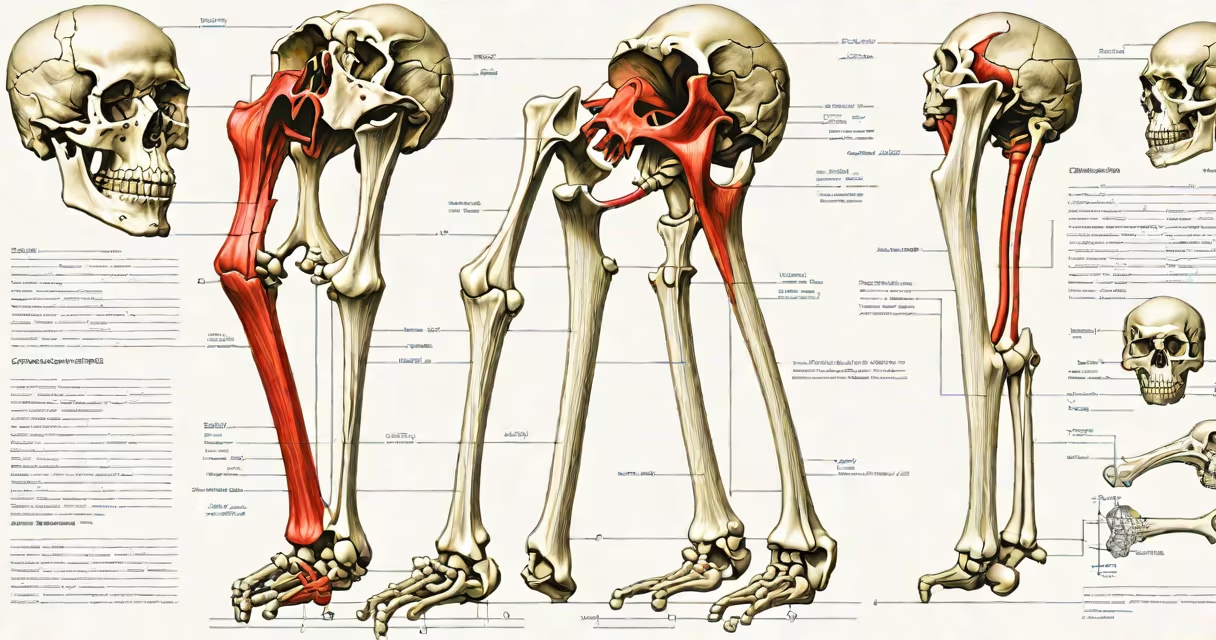
The femur, or thighbone, is the longest and strongest bone in the human body. Located between the hip and knee joints, it is important for supporting weight and facilitating movement.
The femur connects to the pelvis at the hip joint through a ball-and-socket mechanism, allowing for many motion. At the knee, it forms part of the knee joint along with the tibia and patella. The femur's length and strength make it essential for activities like walking, running, and jumping.
Bones are classified into four main types: long bones (like the femur), short bones (wrist and ankle bones), flat bones (sternum and ribs), and irregular bones (vertebrae). The femur exemplifies a long bone, characterized by its elongated shape and spongy interior filled with marrow.
The femur's primary function is to support the body's weight and enable movement. It bears the force of impact during activities like running or jumping. The femur also houses the femur's head, which fits into the acetabulum of the pelvis, forming a stable yet mobile joint.
Many people assume the spine or the jawbone is the largest bone. However, the femur holds this title due to its length and robustness. Another misconception is that the femur is purely structural; it also plays a role in blood cell production through the marrow it contains.
I once observed a medical animation showing the femur's role in a hip replacement surgery. The detailed visualization highlighted how the femur's structure allows for the precise fitting of prosthetic components, underscoring its importance in medical procedures.
| Bone Type | Examples | Primary Function |
|---|---|---|
| Long Bone | Femur, humerus | Support weight, help movement |
| Short Bone | Wrist and ankle bones | Provide stability and support |
| Flat Bone | Sternum, ribs | Protect internal organs |
| Irregular Bone | Vertebrae | Support and protect spinal cord |
Consider the femur's role in a typical day: when you stand up from a chair, the femur bears your body weight. As you walk, it acts as a lever, transmitting forces from your upper body to your legs. This complex interplay of strength and flexibility makes the femur indispensable for mobility.
The femur's significance extends beyond its size; it's a critical component of the skeletal system, influencing health and mobility. Understanding its functions and structure can provide insights into maintaining bone health and preventing injuries.