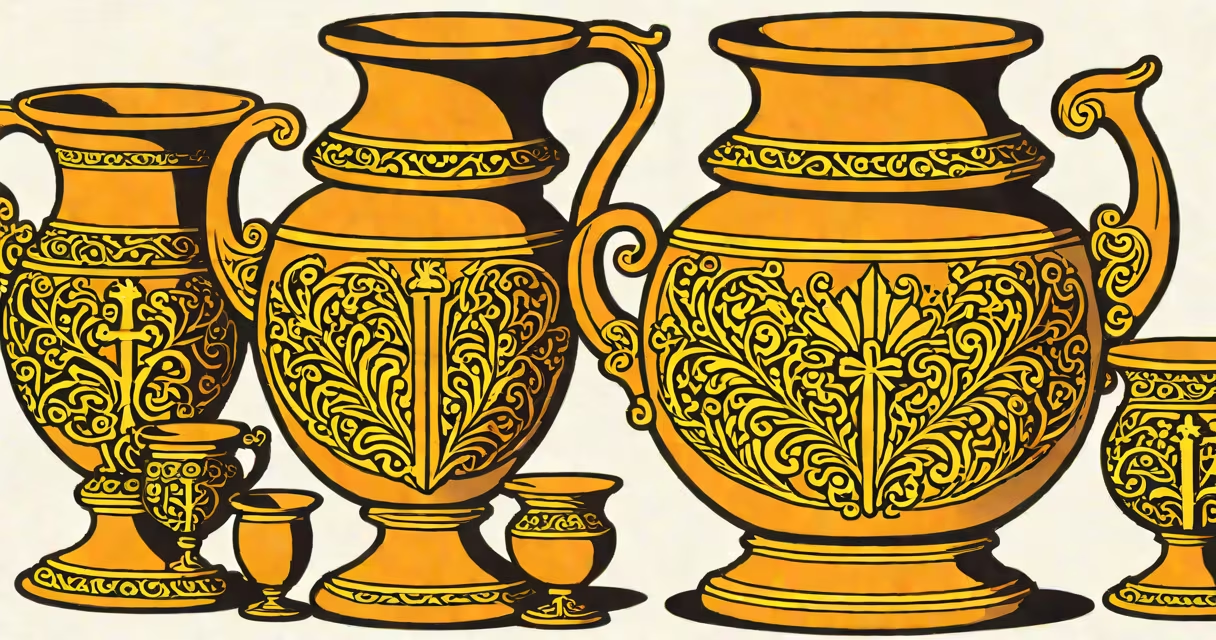
A **pot** in religious contexts is a sacred vessel used to hold and consecrate holy substances, most commonly wine during the Sacrament of the Eucharist in Catholicism. These containers are typically made of glass, metal, or stone and serve both practical and symbolic functions in worship.
Pots used in religious ceremonies are designed to safely contain and pour liquids, often with a narrow neck to prevent spillage. During the Eucharist, for example, a priest fills the pot with wine, which is then consecrated and transformed into the blood of Christ. The design ensures the liquid remains pure and uncontaminated throughout the ritual.
The most common types of religious pots include:
While chalices are the most well-known, other vessels like ciboria and pyxes play important roles in different aspects of the sacrament.
Religious pots are primarily used in Christian liturgical traditions, particularly within Catholicism. They appear in churches during Mass, where they hold the elements necessary for the Eucharist. Beyond their practical use, these vessels symbolize the sacredness of the rituals they support. For instance, the chalice represents the blood of Christ, while the ciborium signifies the unity of the Church.
One frequent misunderstanding is that all religious pots are called "chalices." While chalices are the most recognizable, other vessels like ciboria and pyxes serve distinct purposes., some assume these pots are purely decorative, but their primary function is ritualistic and symbolic.
Another misconception is that only Catholics use these vessels. While Catholicism is the most prominent tradition employing them, other Christian denominations, such as Eastern Orthodoxy and some Anglican churches, also use similar vessels in their liturgical practices.
During a typical Catholic Mass, the priest begins the Eucharistic rite by placing wine into a chalice. After consecration, the wine is believed to become the blood of Christ. The chalice is then used to distribute communion to the congregation. Meanwhile, any leftover hosts (wafer) are stored in a ciborium and kept in the tabernacle until the next service or distributed to the sick.
I once observed a Mass where the priest accidentally dropped the chalice. The congregation held its breath as the vessel shattered, but the wine remained contained within a protective liner-a feature often overlooked but important for preventing spills during such accidents.
Understanding the definition of pots in religious contexts reveals their deep significance in rituals like the Eucharist. These vessels are not just practical tools but symbols of faith and tradition. Whether it's a chalice holding consecrated wine or a ciborium storing the host, each pot plays a important role in the spiritual life of believers. For more on religious rituals, explore the 7 sacraments definition.