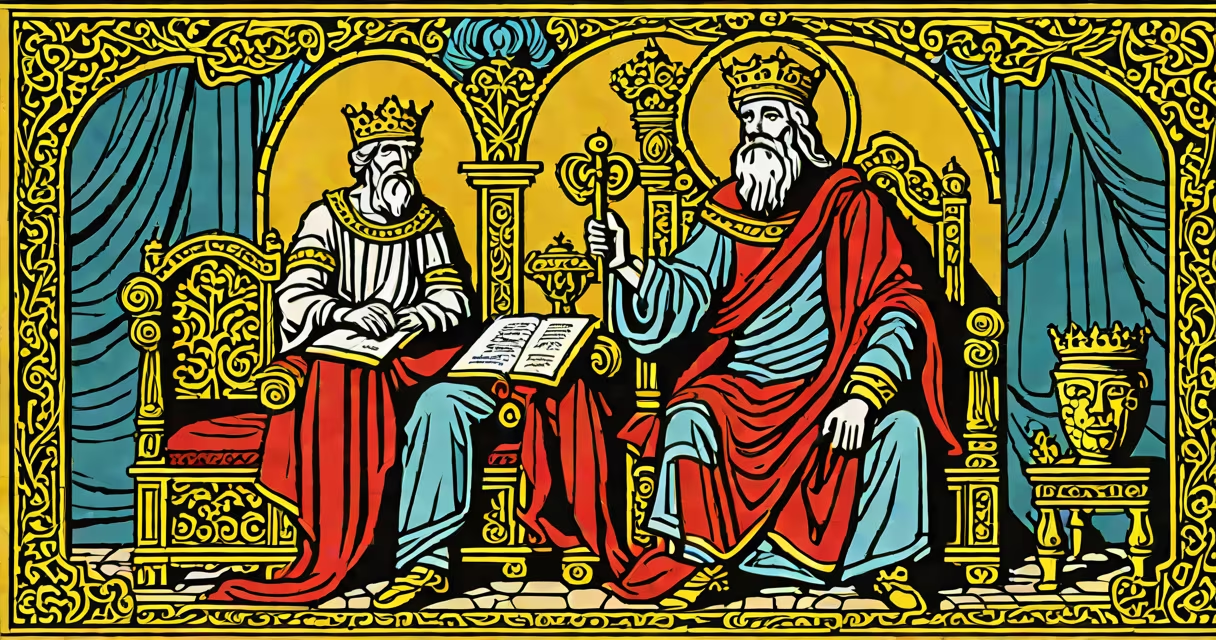
King David committed several serious sins recorded in the Hebrew Bible, including adultery, murder, and deceit. These actions led to severe consequences for him and his family.
The two most infamous sins attributed to David are his adultery with Bathsheba and the murder of her husband Uriah the Hittite. These events are detailed in 2 Samuel 11-12. David saw Bathsheba bathing, sent for her, and slept with her while she was married. When she became pregnant, David arranged for Uriah to be killed in battle to cover up the affair.
God sent the prophet Nathan to confront David about his sins. In 2 Samuel 12:7-14, Nathan tells David a parable about a rich man who stole a poor man's lamb, which David recognized as unjust. Nathan then revealed that David was the rich man in the story, and his actions were equally unjust. As punishment, God declared that violence and conflict would plague David's family forever.
This prophecy came to pass with the rape of David's daughter Tamar by her half-brother Amnon, followed by the murder of Amnon by Tamar's full brother Absalom. Absalom later led a rebellion against David, forcing him to flee Jerusalem. Although David eventually regained his throne, the family remained fractured.
Beyond the Bathsheba incident, David committed other sins. In 1 Samuel 21:1-6, he pretended to be insane to avoid capture by Achish, king of Gath. While this deception saved his life, it was still dishonest., in 1 Chronicles 21:1, David conducted a census of Israel, which was seen as an expression of pride and reliance on military strength rather than trust in God. This act led to a plague that killed 70,000 Israelites.
Despite his sins, David is often portrayed as a penitent figure. Psalm 51 is traditionally attributed to David as an expression of his remorse for the Bathsheba and Uriah incidents. The psalm includes the famous lines, "Create in me a clean heart, O God, and renew a right spirit within me" (Psalm 51:10).
David's repentance is seen as a key part of his legacy. While his sins were severe, his willingness to acknowledge them and seek forgiveness is highlighted in biblical texts. This aspect of his story has made him a complex figure in religious tradition, representing both human fallibility and the possibility of redemption.
For more on biblical figures with complex legacies, see our guide on the symbolic meanings behind dragons in mythology.