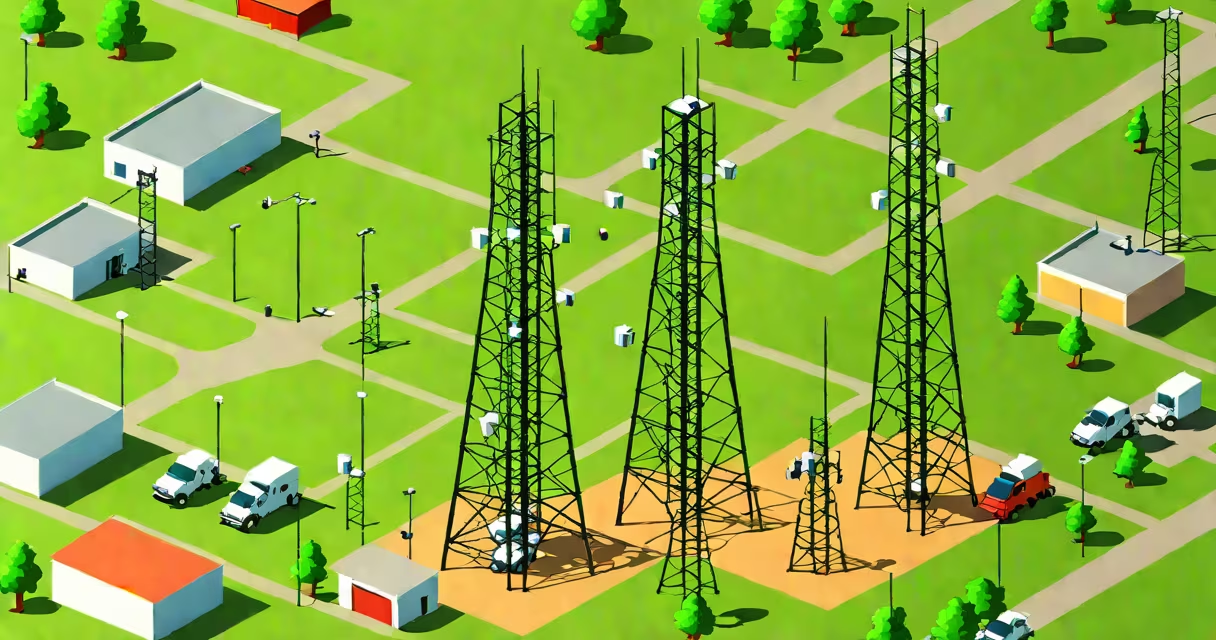
US Cellular operates a mix of macrocells, small cells, and distributed antenna systems (DAS) to provide coverage across its service areas. These towers and sites form the core of US Cellular's wireless network infrastructure.
US Cellular maintains three primary types of cell sites:
Each cell site contains radio transceivers that communicate with mobile devices using licensed spectrum. US Cellular operates on multiple frequency bands, including low-band (600 MHz, 700 MHz) for wide-area coverage and mid-band (PCS, AWS) for capacity.
The carrier uses heterogeneous networks (HetNets), combining different cell types to balance coverage and capacity. Macrocells handle wide-area coverage, while small cells and DAS handle concentrated traffic in urban areas and venues.
US Cellular partners with tower companies like American Tower Corporation and Crown Castle to expand coverage through tower leasing agreements. The carrier also builds its own towers in rural areas where coverage is sparse.
Contrary to popular belief, US Cellular doesn't rely solely on its own towers. The carrier maintains roaming agreements with other networks (including AT&T and T-Mobile) to provide coverage in areas where its own infrastructure is limited.
Another myth is that all cell towers look alike. US Cellular's infrastructure varies from traditional lattice towers to stealth towers disguised as trees or flagpoles, particularly in suburban and rural areas.
In Chicago, US Cellular combines 11 macrocells with 42 small cells and 3 DAS installations to cover the city. The small cells handle high-density areas like downtown and Wrigleyville, while macrocells provide coverage to the suburbs. This mix allows US Cellular to offer reliable service during events like Cubs games and music festivals.