The electron was discovered in 1897 by physicist J.J. Thomson through experiments with cathode rays. This breakthrough revealed the first subatomic particle and fundamentally changed our understanding of atomic structure.
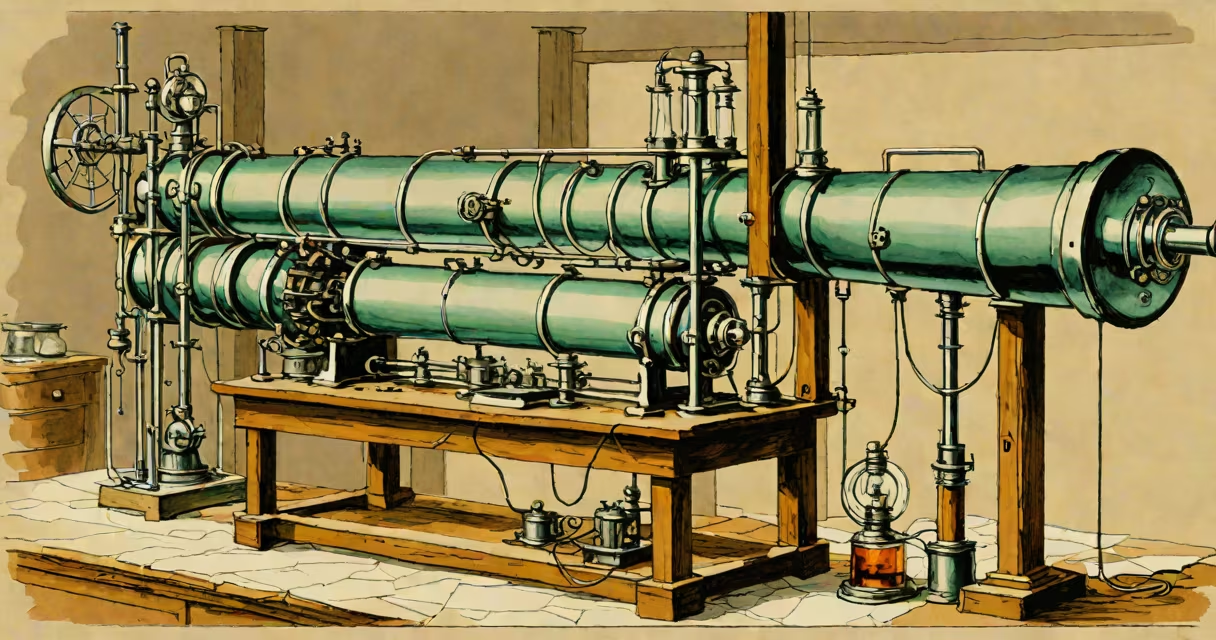
Thomson conducted experiments using a cathode ray tube, a device that produces beams of particles when an electric current is passed through a gas at low pressure. By applying electric and magnetic fields, he observed that the rays were deflected like negative electrical charges. This led him that the rays consisted of negatively charged particles, which he called "corpuscles"-later renamed electrons.
Electrons are fundamental particles with a negative elementary electric charge. They are incredibly small, with a mass approximately 1/1836th that of a proton. Thomson's discovery showed that atoms were not indivisible, as previously believed, but composed of smaller particles.
The discovery of the electron revolutionized atomic theory. Before this, atoms were thought to be the smallest units of matter. Thomson's work led to the plum pudding model, where electrons were embedded in a positively charged matrix. This was later refined by Rutherford and Bohr into the nuclear model we recognize today.
This discovery also paved the way for quantum mechanics and the development of electronics. Without understanding electrons, technologies like transistors, computers, and many other modern devices would not exist.
Many people confuse the discovery of the electron with the discovery of the nucleus. The nucleus was identified later by Ernest Rutherford in 1911 through his gold foil experiment. Another misconception is that electrons were the first subatomic particles discovered; actually, the proton was identified around the same time by Eugene Goldstein.
While I haven't personally replicated Thomson's experiment, visiting the Cavendish Laboratory at the University of Cambridge-where the electron was discovered-was a fascinating experience. Seeing the historical equipment and learning about the meticulous work Thomson conducted firsthand provided a deeper appreciation for the significance of this discovery.