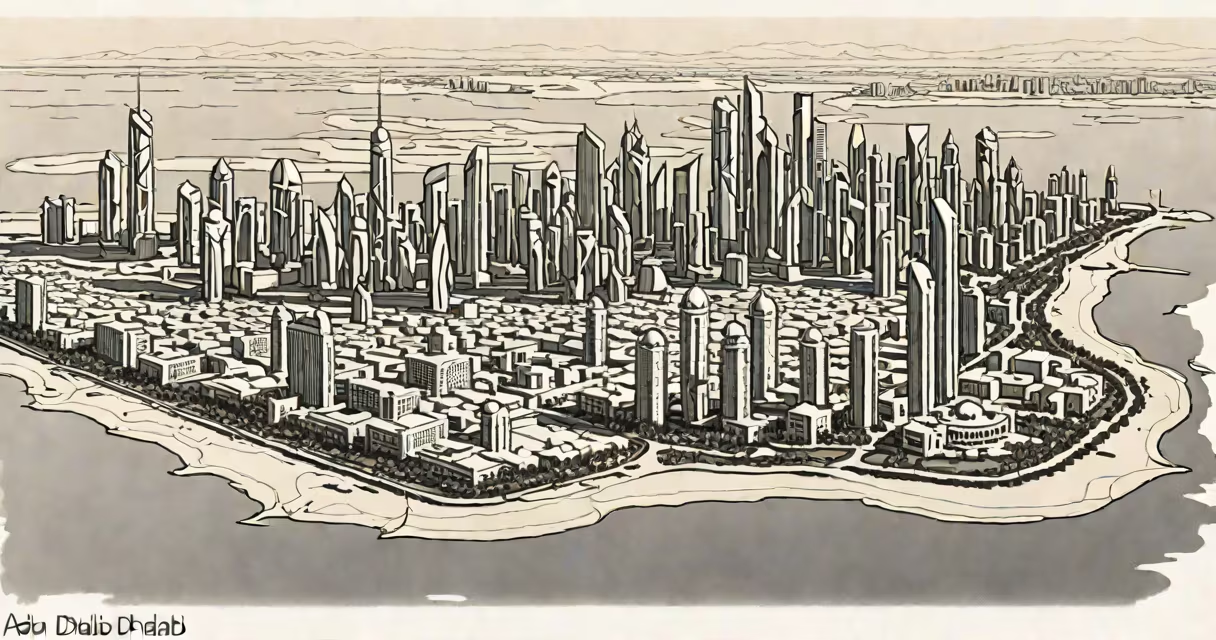
Abu Dhabi is the capital of the United Arab Emirates (UAE), situated on a T-shaped island in the Persian Gulf. This coastal city lies roughly 140 kilometers southwest of Dubai, the UAE's most populous city.
Abu Dhabi's precise coordinates are 24.4667° N latitude and 54.3667° E longitude. The city occupies an area of about 972 square kilometers, including the main island and several smaller islands nearby.
The emirate of Abu Dhabi covers approximately 86,000 square kilometers, making it the largest of the seven emirates that comprise the UAE. It shares land borders with Oman to the east and south, while Saudi Arabia lies to the west.
Abu Dhabi's main island is connected to the mainland by three bridges: Maqta Bridge, Mussafah Bridge, and Sheikh Zayed Bridge. The city's layout features wide boulevards, modern skyscrapers, and extensive green spaces.
Abu Dhabi has a hot desert climate with very hot summers and mild winters. Average temperatures range from 15°C (59°F) in January to 33°C (91°F) in July. The city receives minimal rainfall, averaging less than 100 millimeters per year.
The city's environment includes both natural and man-made elements. The Persian Gulf coastline features beaches and coral reefs, while extensive urban development has created a modern metropolis. The city's growth has led to new water management solutions, including desalination plants and wastewater recycling systems.
The city's educational field includes prestigious universities and research institutions, contributing to its growing reputation as a knowledge hub in the region. Abu Dhabi's cultural scene continues to evolve, with new initiatives and projects enhancing its status as a global city.