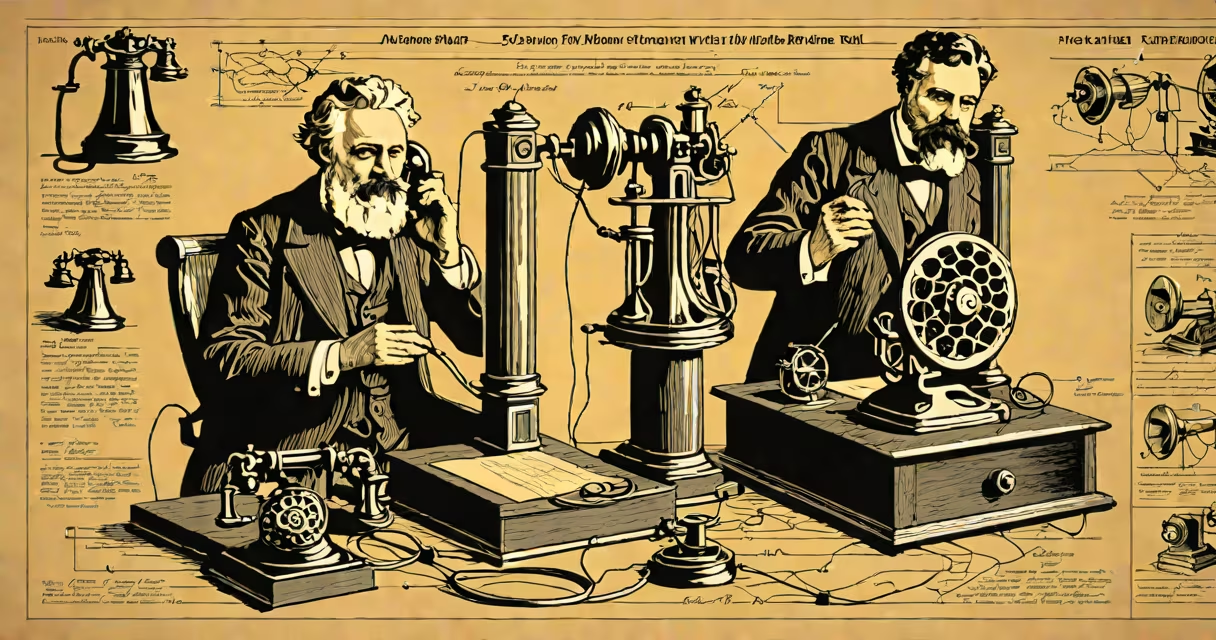
The telephone was invented to bridge long-distance communication gaps more efficiently than existing methods like the telegraph. Its creation stemmed from a combination of scientific curiosity, commercial potential, and personal ambition.
The telephone converted sound waves into electrical signals that traveled through wires, then reconstructed them as audible sound at the receiving end. This differed from the telegraph, which transmitted coded pulses representing letters or numbers.
| Type | Key Feature | Year Introduced |
|---|---|---|
| Liquid transmitter | Used a membrane and liquid to convert sound | 1876 |
| Carbon microphone | More sensitive, used carbon granules | 1878 |
| Magneto phone | Self-contained unit with built-in generator | 1878 |
Early telephones appeared in businesses and homes, primarily in urban areas. They replaced written correspondence and face-to-face meetings for many routine communications. The first commercial telephone exchange opened in New Haven, Connecticut in 1878, serving businesses in the downtown area.
One common misconception is that the telephone was invented solely to help the hearing impaired. While Alexander Graham Bell did work with deaf students, his primary motivation was creating a practical communication device for the general public.
Consider the 1876 demonstration where Bell transmitted the famous words "Mr. Watson, come here-I want to see you" through his prototype. This wasn't just a scientific experiment-it showed the telephone could replace messengers for immediate communication between offices. Within months, businesses were installing telephone lines to coordinate operations across buildings.
I once visited the original Bell Telephone Memorial in Brantford, Ontario, where Bell made his famous test call. The site includes replicas of his workshop and early telephone models, showing how compact these early devices were compared to modern versions.
Elisha Gray, another inventor, filed a caveat (a type of provisional patent) for a liquid transmitter the same day Bell filed his patent. The U.S. Patent Office awarded the patent to Bell, sparking decades of legal battles. This dispute led to the formation of the Bell Telephone Company, which became American Telephone and Telegraph Company (AT&T) in 1885.
According to the U.S. National Park Service, Bell's patent (number 174,655) covered "the method of, and apparatus for, transmitting vocal or other tones telephonically," and remained in effect until 1893. The legal battles over this patent helped establish important precedents in telecommunications law.