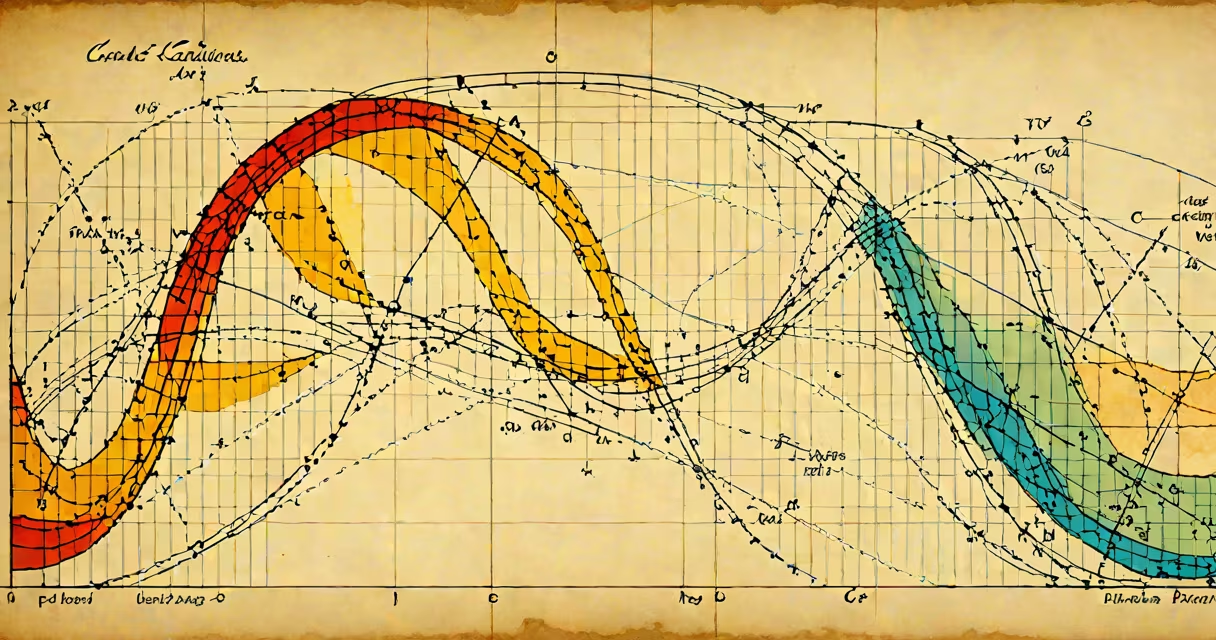
Calculus is a major branch of mathematics that studies continuous change using derivatives and integrals. It provides tools to analyze functions by measuring their rates of change and the areas under curves.
Calculus builds on algebra, geometry, and trigonometry. It introduces concepts like limits, derivatives, and integrals to solve problems involving motion, area, volume, and optimization. The subject is divided into differential calculus (derivatives) and integral calculus (integrals), which are connected by the fundamental theorem of calculus.
Calculus operates through two main processes: differentiation and integration. Differentiation calculates how a function changes as its input changes, while integration sums infinitesimal data to find areas, volumes, and other totals. These processes are inverse operations, forming the core of calculus.
For example, if you have a function representing the position of a moving object over time, differentiation gives its velocity at any point, and integration gives the total distance traveled. This duality allows calculus to model changing systems precisely.
| Type | Focus | Key Concepts |
|---|---|---|
| Differential Calculus | Rates of change | Derivatives, slopes of tangent lines, optimization |
| Integral Calculus | Accumulation of quantities | Integrals, areas under curves, volumes of solids |
| Multivariable Calculus | Functions of multiple variables | Partial derivatives, multiple integrals, vector calculus |
Differential calculus examines how quantities change, while integral calculus focuses on accumulating small pieces to find totals. Multivariable calculus extends these ideas to functions with multiple inputs, important for advanced applications in physics and engineering.
Calculus is applied in physics to describe motion, forces, and energy. In engineering, it helps design structures, circuits, and control systems. Economists use calculus to model market behavior and improve resource allocation. Even in biology, calculus models population growth and the spread of diseases.
A common misconception is that calculus is only for scientists and engineers. However, it's also used in machine learning algorithms, cryptography, and even in analyzing trends in social media data. Its versatility makes it indispensable across many fields.
Many people confuse calculus with algebra, thinking it's just advanced arithmetic. While algebra deals with static relationships between quantities, calculus focuses on changing changes. Another mistake is assuming calculus is only useful for theoretical work-it's widely applied in practical, real-world scenarios.
For instance, calculus helps GPS devices calculate the shortest route between two points by minimizing distance. It also optimizes manufacturing processes by reducing waste and maximizing efficiency. These applications show calculus's practical value beyond academic settings.
I once used calculus to improve the trajectory of a model rocket. By calculating the derivative of the height function, I determined the rocket's maximum altitude and adjusted its angle for better performance. This hands-on experience demonstrated calculus's power in solving real problems.
The definition of calculus in mathematics encompasses the study of change using derivatives and integrals. It provides essential tools for analyzing changing systems, optimizing processes, and solving complex problems across various fields. Understanding calculus opens doors to advancements in science, engineering, and technology, making it a key part of modern education.