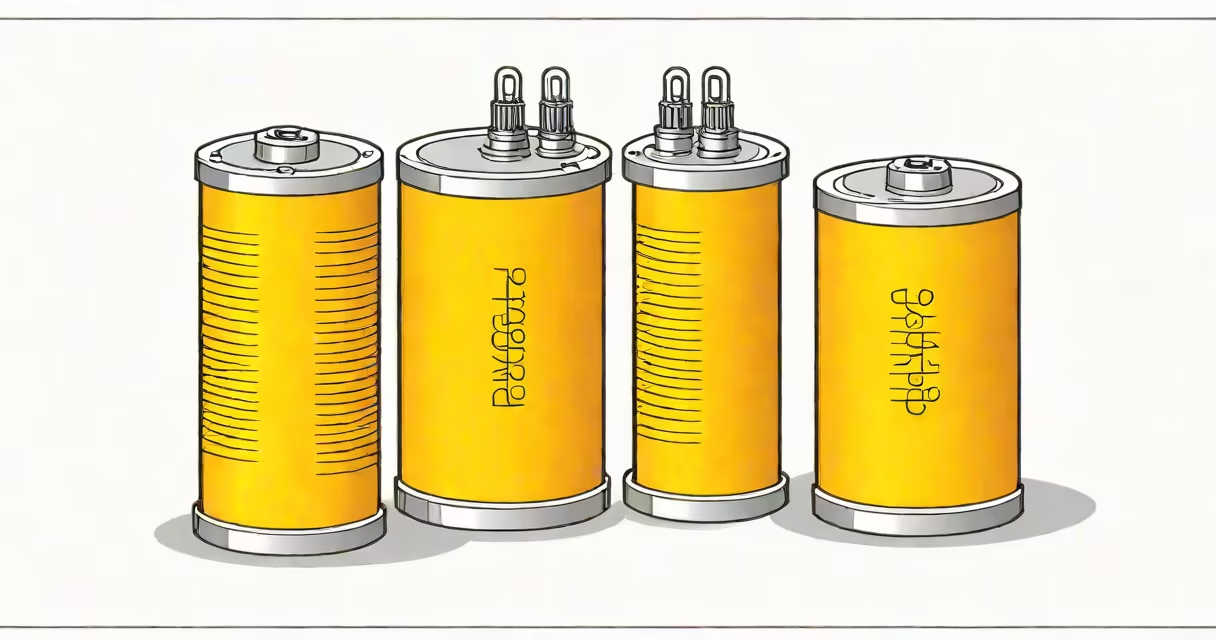
A capacitor is a passive electronic component that stores electrical energy in an electric field when voltage is applied. It consists of two conductive plates separated by an insulating material called a dielectric.
When a voltage is applied across the plates, an electric field forms in the dielectric. This field creates a potential difference that allows the capacitor to store charge. The amount of charge stored is proportional to the voltage and the capacitor's capacitance value.
Capacitors come in various types, each suited for different applications:
| Type | Dielectric Material | Common Uses |
|---|---|---|
| Ceramic | Ceramic material | High-frequency circuits, decoupling |
| Electrolytic | Electrolyte solution | Power supplies, audio circuits |
| Film | Plastic film | Timing circuits, motor start capacitors |
| Supercapacitor | Carbon electrodes | Energy storage, regenerative braking |
The performance of a capacitor is characterized by several key parameters:
One common misconception is that capacitors store "energy" like batteries. While they do store electrical energy, they release it much faster than batteries. Another mistake is assuming all capacitors are the same; different types have vastly different characteristics and uses.
For instance, electrolytic capacitors are polarized and can be damaged if connected backward, while ceramic capacitors are non-polarized and can be connected in any orientation. Understanding these differences is important for proper circuit design.
In my experience working with electronics, I've seen capacitors used in various applications. For example, in a simple flashlight circuit, a capacitor can store energy from the battery and release it quickly to power the LED, creating a bright flash. This is different from a battery, which releases energy slowly over time.
Another example is in power supplies, where capacitors smooth out voltage fluctuations and provide stable power to sensitive electronic components. Without capacitors, these components would be subject to voltage spikes and drops, which can cause malfunctions or damage.
The definition of capacitor in physics is fundamental to understanding how these components work in electronic circuits and power systems. By storing and releasing electrical energy, capacitors play a important role in many applications, from simple flashlights to complex quantum experiments.