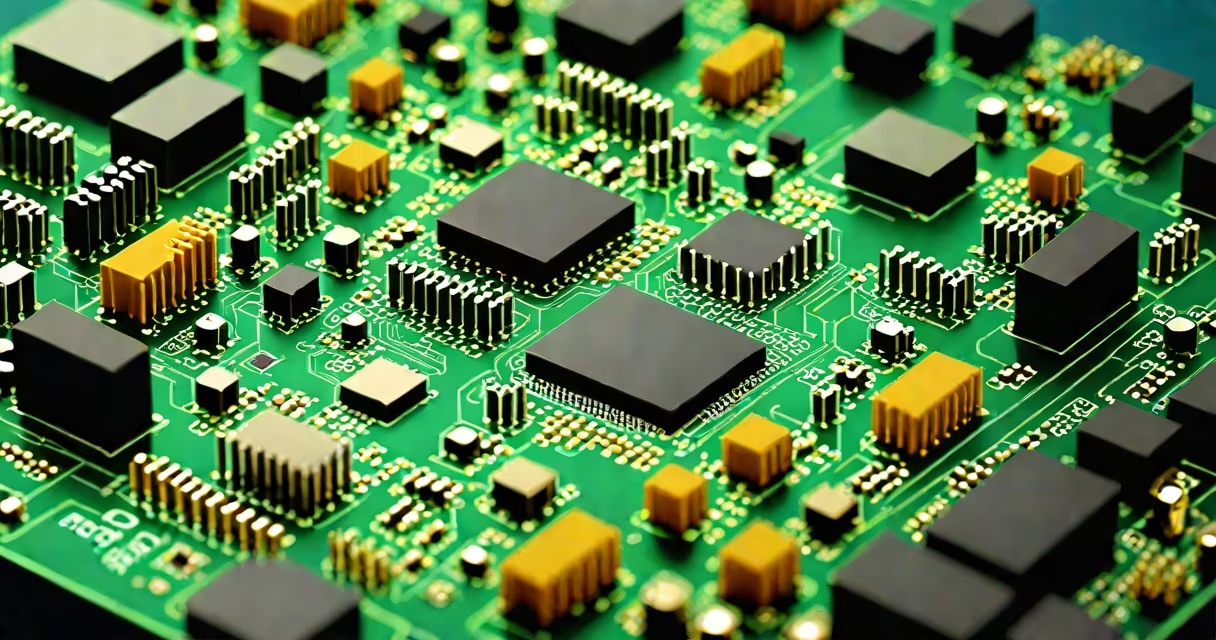
Hardware and software co-design is an engineering approach that develops computer chips and their accompanying programs simultaneously to maximize efficiency. Unlike traditional methods that separate hardware and software development, co-design treats them as interdependent parts of a single system.
Co-design begins with a high-level specification of the desired system. Engineers then explore different hardware-software partitions, determining which functions should run on programmable processors and which should be implemented in custom hardware. This process uses specialized tools that simulate both hardware and software components together.
The most common types of co-design are:
| Type | Description | Example Application |
|---|---|---|
| System-on-Chip (SoC) | Integrates multiple hardware components and processors onto a single chip, with custom software for each component | Smartphones, tablets |
| FPGA-Based Design | Uses field-programmable gate arrays that can be reconfigured to implement different hardware functions as needed | Prototyping, signal processing |
| Embedded Systems | Combines microcontrollers with custom firmware to control specific devices or processes | Automotive systems, industrial automation |
Co-design is important for modern computing systems because it enables significant improvements in performance, power efficiency, and cost. By optimizing both hardware and software together, engineers can create systems that meet strict requirements for battery life, processing speed, and form factor.
According to the IEEE Computer Society, co-design can reduce power consumption by up to 50% compared to traditional design methods. This is particularly important for mobile devices and wearable technologies, where battery life is a critical concern.
Many people confuse hardware and software co-design with simply writing efficient software for existing hardware. However, co-design goes much further by actually modifying the hardware architecture to better support the software requirements. For instance, a co-designed system might include specialized hardware units for encryption, video decoding, or sensor data processing that wouldn't exist in a general-purpose processor.
As computing systems become more complex and diverse, the importance of co-design will continue to grow. Emerging applications in artificial intelligence, edge computing, and the Internet of Things all demand highly optimized hardware-software solutions. Tools and methodologies for co-design are evolving to meet these challenges, making it an exciting field for engineers and researchers alike.