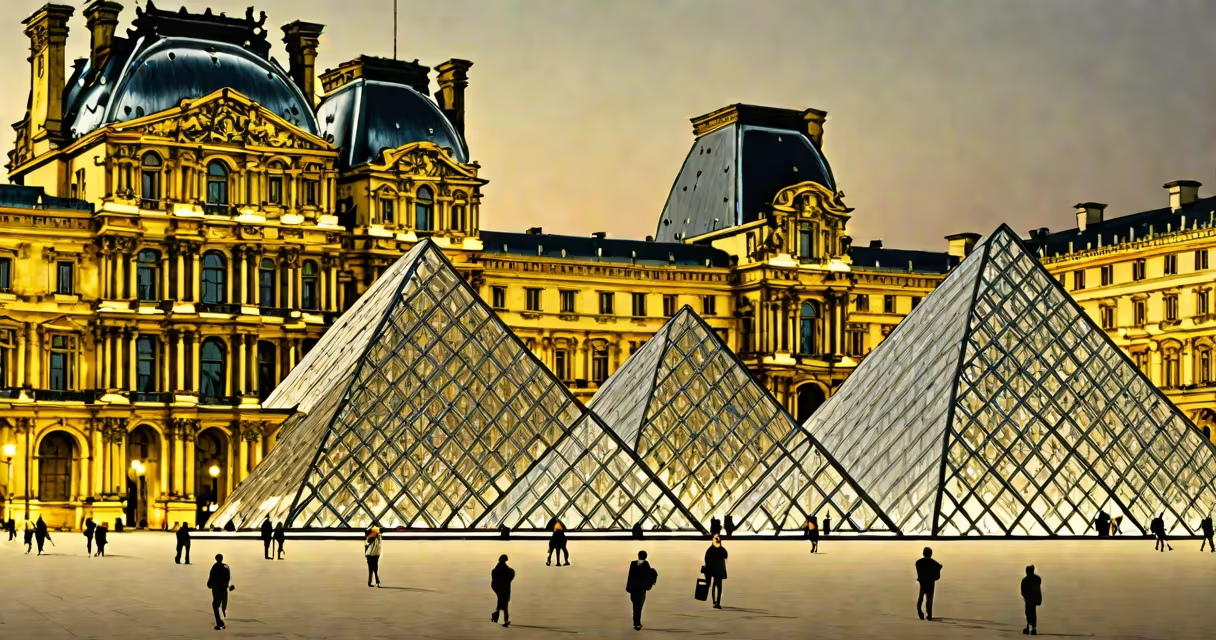
I.M. Pei was the Chinese-American architect who designed the Louvre Pyramid, the 21-meter-tall glass and metal pyramid at the Louvre Museum's courtyard in Paris. Completed in 1989, this modern addition contrasts with the historic palace while serving as its main entrance.
Born in Guangzhou in 1917, Ieoh Ming Pei moved to the United States for architecture studies. He became a pioneer of modernist architecture, known for his geometric forms and new use of materials. The Louvre project came through a direct commission from French President François Mitterrand in 1983.
The pyramid consists of 675 glass panels and 70 metal ribs, covering 1,000 square meters. Its base aligns with the Louvre's underground visitor center. Pei chose glass to reflect the sky and blend with the surrounding architecture rather than compete with it.
Construction required precise engineering to ensure stability and transparency. The pyramid's structure sits on a concrete foundation, while its glass panels tilt slightly inward for structural integrity. This design allows natural light to flood the underground lobby below.
When first proposed, the design faced criticism from traditionalists who saw it as too modern for the historic site. However, the pyramid quickly became a landmark and symbol of the Louvre's modernization. Today, it attracts millions of visitors annually and appears on countless postcards.
Pei's design solved practical problems like crowd control and security while creating an iconic entrance. The pyramid's success led to additional glass structures in the Louvre's courtyard, including a smaller pyramid and two twin pyramids.
The Louvre Pyramid remains one of Pei's most famous works and a prime example of modern architecture blending with historic sites. It demonstrates how contemporary design can improve rather than detract from cultural heritage.
In 2019, the Louvre celebrated the pyramid's 30th anniversary with special exhibitions and events. The structure continues to serve as both an entrance and a symbol of the museum's evolution over centuries.