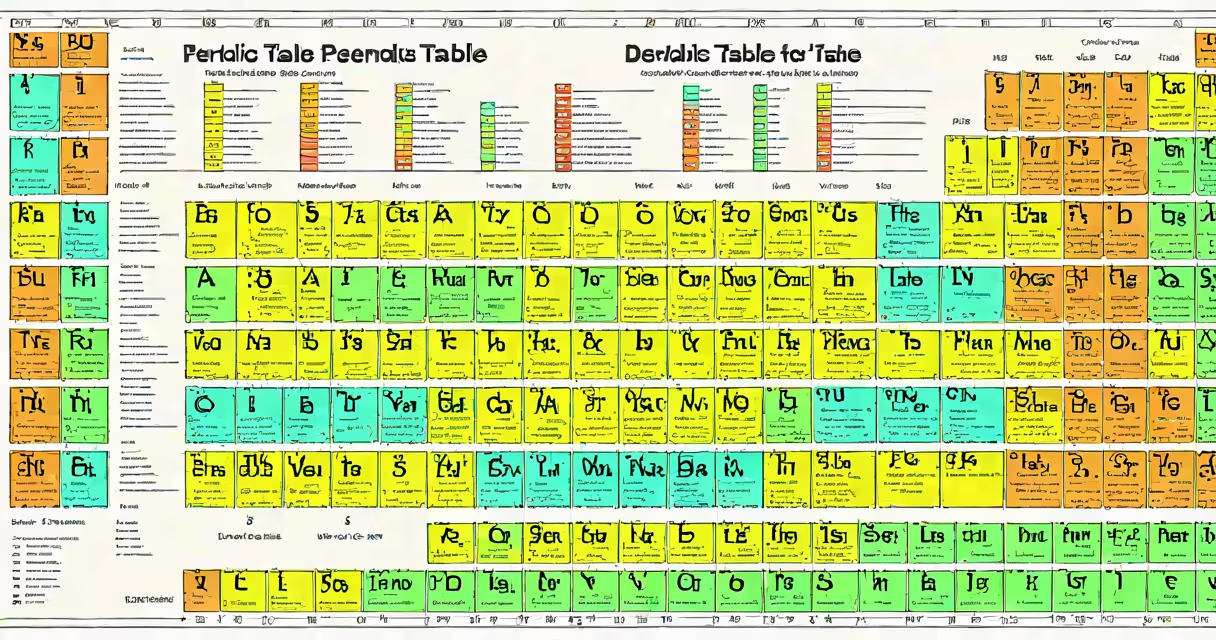
A periodic table sheet is a tabular arrangement of all known chemical elements, organized by increasing atomic number and grouped by recurring chemical properties. This layout reveals patterns in element behavior and reactivity.
The periodic table arranges elements in rows called periods and columns called groups. Each element is represented by its atomic number, symbol, and name. Elements in the same group share similar properties because they have the same number of electrons in their outer shell.
For example, all Group 1 elements (like hydrogen, lithium, and sodium) are highly reactive metals that readily form compounds with other elements. This predictability makes the periodic table a useful tool for chemists.
While all periodic tables share the same basic structure, they may differ in design and additional information included. Common variations are:
| Type | Key Features | Best For |
|---|---|---|
| Standard | Atomic number, symbol, name, atomic weight | General reference |
| Color-coded | Groups by element categories (metals, nonmetals, etc.) | Visual learners |
| Expanded | Includes electron configurations, electronegativity values | Advanced study |
Chemists and students use periodic table sheets daily to understand element behavior, predict chemical reactions, and identify unknown substances. The table's organization reflects the periodic law, which states that element properties become repetitive when arranged by atomic number.
For instance, when determining how sodium (Na) reacts with chlorine (Cl), chemists refer to their positions in Groups 1 and 17 respectively. Group 1 elements typically form +1 ions, while Group 17 elements form -1 ions, leading to the formation of NaCl (table salt).
Many people confuse the periodic table with a mere list of elements. In reality, it's a sophisticated tool that reveals deep relationships between elements. Another misconception is that the table is static - in fact, new elements continue to be added as they're discovered and confirmed.
For example, in 2016, four new elements were added to the periodic table: nihonium (Nh), moscovium (Mc), livermorium (Lv), and tennessine (Ts). These superheavy elements were created in laboratories and have extremely short half-lives.
I remember first using a periodic table sheet in high school chemistry class. We had to identify an unknown metal by observing its reaction with various solutions. By referring to the table, we could narrow down possibilities based on expected behaviors for elements in certain groups.
Beyond education, periodic table sheets are essential in industries like pharmaceuticals, materials science, and environmental analysis. They help researchers develop new compounds, understand material properties, and assess chemical safety.
For more details on how the periodic table is structured and its history, see our guide on the periodic table. To learn about specific elements like D on the periodic table, explore our dedicated articles.