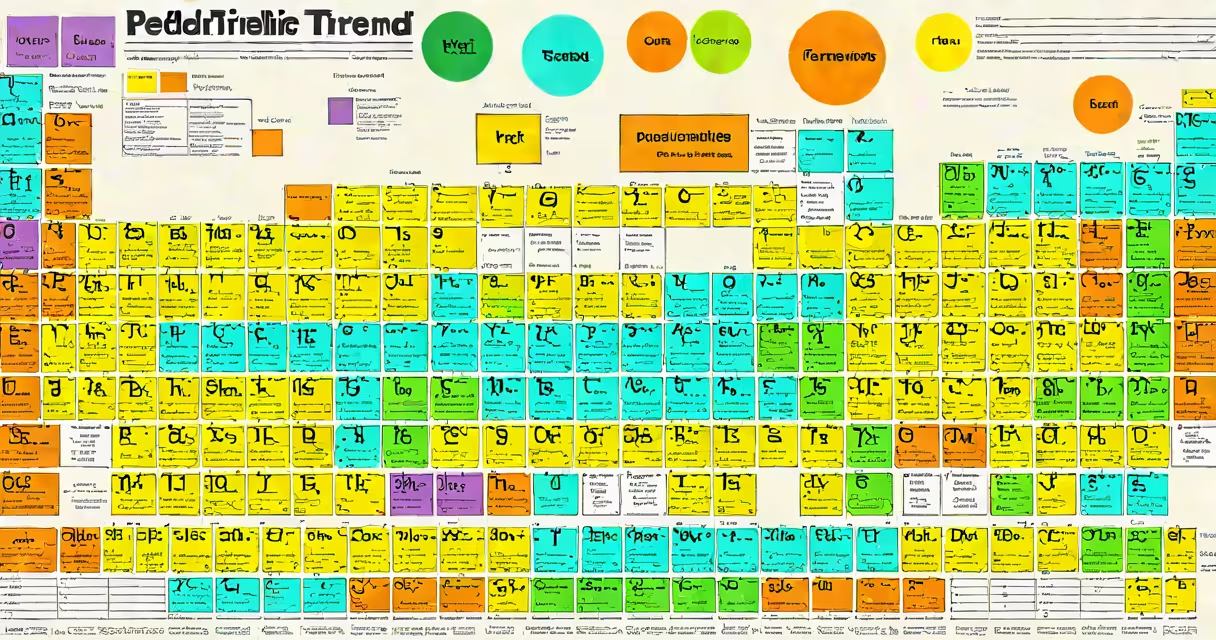
Periodic trends are patterns in element properties that repeat across rows (periods) and columns (groups) of the periodic table. These trends emerge because elements in the same group have similar electron configurations.
As you move across a period, atoms gain protons and electrons. This increases nuclear charge, pulling electrons closer and making the atom smaller. Conversely, moving down a group adds electron shells, increasing atomic size despite added protons.
For example, lithium (Li) has an atomic radius of 167 pm, while fluorine (F) in the same period has a radius of just 54 pm. But moving (Fr) in Group 1 increases the radius to 302 pm due to added electron shells.
| Trend | Direction | Example |
|---|---|---|
| Atomic Radius | Decreases across periods, increases down groups | F (54 pm) vs. Cl (99 pm) vs. Br (115 pm) |
| Ionization Energy | Increases across periods, decreases down groups | Li (520 kJ/mol) vs. Na (496 kJ/mol) |
| Electronegativity | Increases across periods, decreases down groups | Cs (0.79) vs. Fr (0.7) in Group 1 |
| Metallic Character | Decreases across periods, increases down groups | B (metalloid) vs. Al (metal) in Group 13 |
Chemists use periodic trends to predict element behavior without experimentation. For instance, knowing that fluorine is the most electronegative element explains why it forms compounds where it always attracts bonding electrons.
Trends also help identify anomalies. For example, oxygen has a lower electronegativity than expected due to electron repulsion in its half-filled 2p orbital. This explains why water (H₂O) is bent rather than linear.
Many assume trends are absolute, but exceptions exist. For example, gallium (Ga) has a higher ionization energy than aluminum (Al) due to poor shielding by d-electrons. Similarly, noble gases defy trends by having higher ionization energies than halogens.
Another mistake is assuming trends apply equally to all properties. While ionization energy generally increases across periods, electron affinity sometimes decreases (e.g., ).
Using periodic trends, we can predict that potassium (K) will react more vigorously with water than lithium (Li). Potassium has a lower ionization energy (419 kJ/mol vs. 520 kJ/mol), making it easier to lose electrons and form K⁺ ions. This explains why potassium explodes violently in water, while lithium merely fizzes.
Similarly, chlorine's high electronegativity (3.16) and low ionization energy (1256 kJ/mol) explain why it forms Cl⁻ ions readily, making it a strong oxidizing agent.
I once tested this by comparing sodium (Na) and cesium (Cs) reactions. Sodium melted dramatically, while cesium burst into bright blue flames-demonstrating how increased reactivity follows the trend of decreasing ionization energy down Group 1.