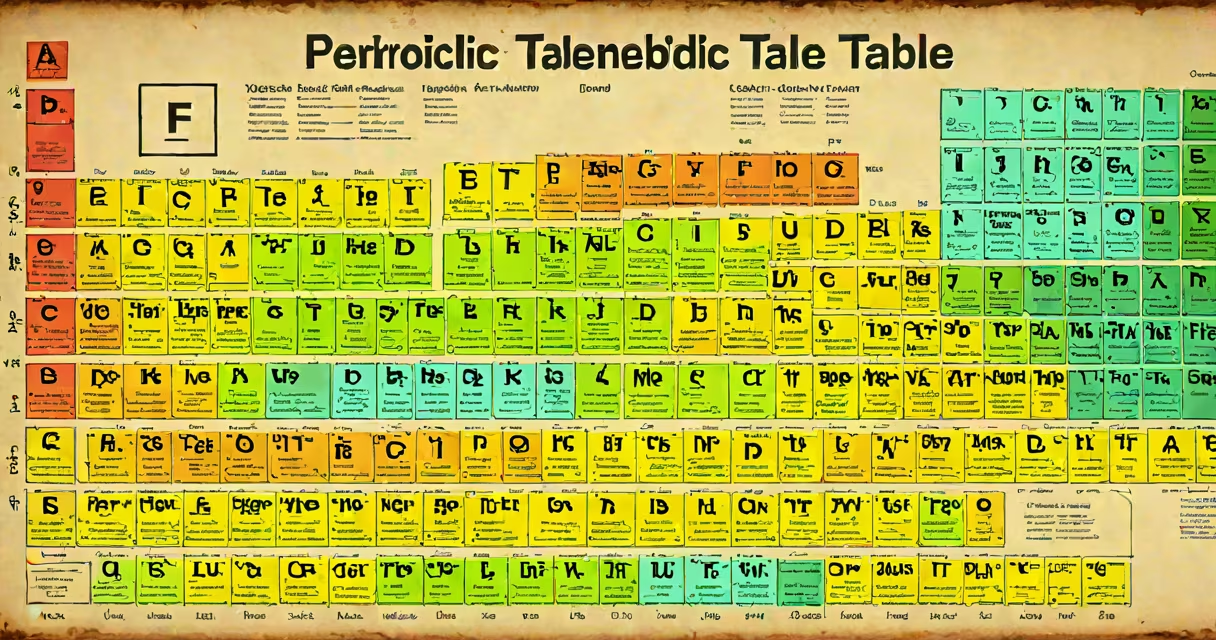
A periodic table with all information is a complete chart displaying every known chemical element, organized by atomic number, electron configurations, and recurring chemical properties. This reference tool includes detailed data about each element's atomic weight, density, melting point, boiling point, and electronegativity.
The periodic table arranges elements in rows and columns based on their atomic number (number of protons). Elements in the same column (group) share similar chemical behaviors. For example, all elements in Group 1 (alkali metals) are highly reactive and form compounds with similar formulas.
Rows (periods) indicate the number of electron shells. Elements in the same period have electrons in the same highest shell, which affects their reactivity and bonding behavior. The table's structure reveals patterns in element properties, such as increasing atomic radius down a group and across a period.
| Type | Examples | Key Characteristics |
|---|---|---|
| Metals | Iron (Fe), Copper (Cu) | Malleable, ductile, good conductors of electricity and heat |
| Nonmetals | Carbon (C), Oxygen (O) | Brittle, poor conductors, exist in various forms (solids, liquids, gases) |
| Metalloids | Silicon (Si), Boron (B) | Properties between metals and nonmetals, used in semiconductors |
| Halogens | Fluorine (F), Chlorine (Cl) | Highly reactive, form salts with metals |
| Noble Gases | Helium (He), Neon (Ne) | Inert, rarely react with other elements |
Chemists use the periodic table to predict how elements will behave in reactions. For instance, knowing that sodium (Na) is an alkali metal helps chemists understand it will react vigorously with water. The table is also essential in education, research, engineering, and industry for material selection and design.
One non-obvious fact: the table's structure predicts new elements. In 1871, Dmitri Mendeleev left gaps for undiscovered elements like germanium (Ge), which was later found and fit the predicted properties.
Many people confuse the periodic table with a simple list of elements. However, its true power lies in the patterns and relationships between elements. For example, hydrogen (H) behaves differently from other elements in its group because it has only one proton and one electron, unlike the larger alkali metals.
Another mistake is assuming all elements in the same group have identical properties. While they share similarities, each element has unique characteristics. For instance, lithium (Li) reacts with water, but it does so less violently than sodium (Na).
Consider oxygen (O), element number 8. Its position in Group 16 (chalcogens) tells us it's highly reactive and forms oxides with most elements. Oxygen's atomic number (8) indicates it has 8 protons and typically 8 electrons, with 6 valence electrons in its outer shell. This configuration explains why oxygen forms two covalent bonds in molecules like H2O (water).
When I taught chemistry, I used oxygen's properties to demonstrate how the periodic table predicts behavior. By analyzing its position and electron configuration, students could deduce its reactivity and common compounds without memorizing facts.