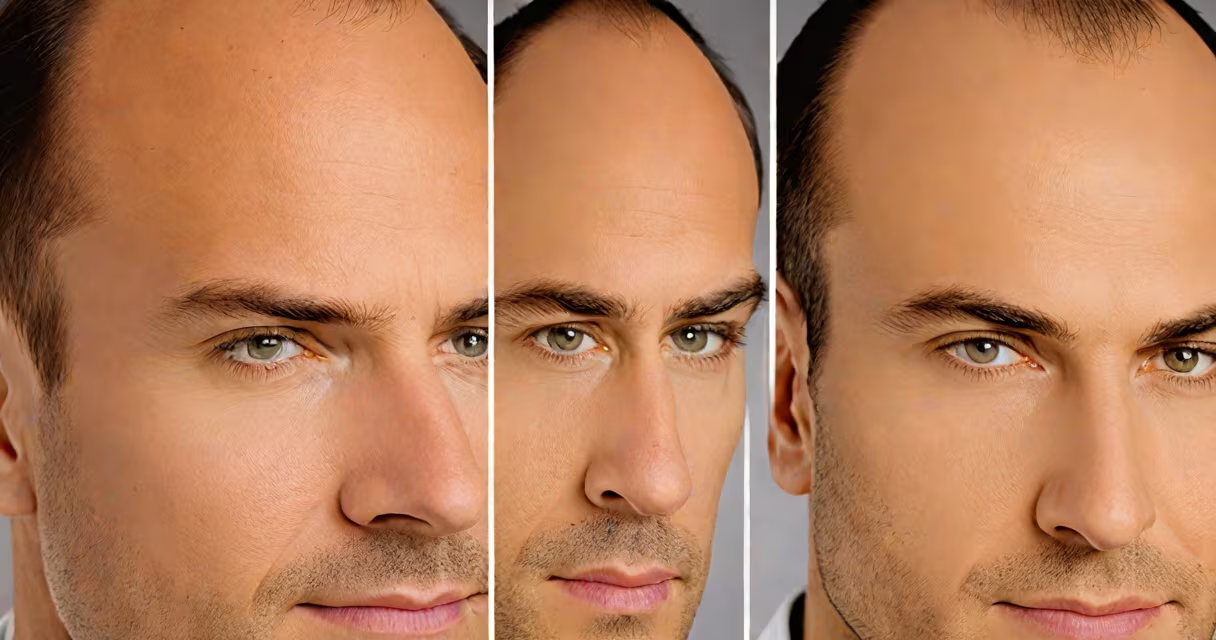
A receding front hairline is the earliest stage of male pattern baldness, where hair thins and pulls back from the forehead. It typically begins in a man's late 20s or early 30s and progresses slowly over time.
This condition, known medically as androgenetic alopecia, affects about 50% of men over age 50. The hairline recedes in an M-shaped pattern, with the temples thinning first. Unlike other forms of hair loss, a receding hairline follows a predictable progression.
Androgenetic alopecia is caused by a combination of genetics and hormones. Dihydrotestosterone (DHT), a derivative of testosterone, shrinks hair follicles until they stop producing new hair. This process starts at the front and top of the scalp, which is why the hairline recedes first.
Each hair follicle has a limited number of growth cycles before it becomes dormant. Once a follicle stops producing hair, it won't grow back without medical intervention. The rate of recession varies by individual, influenced by genetics and lifestyle factors.
| Type | Description | Common Age of Onset |
|---|---|---|
| Type 1 | Minimal recession at the temples | Late teens to early 20s |
| Type 2 | Triangular recession at the temples | Early 20s |
| Type 3 | Deep recession forming an M-shape | Mid-20s to early 30s |
| Type 4 | Extensive recession with thinning crown | Mid-30s |
| Type 5 | Bridge of hair between front and crown disappears | Late 30s |
| Type 6 | Hair loss connects front and crown | 40s and beyond |
Many people assume a receding hairline is purely genetic, but lifestyle factors like stress, diet, and smoking can accelerate it. Another myth is that wearing hats causes hair loss-they don't contribute to baldness, though tight hats may irritate the scalp.
Some believe hair loss only affects older men, but it can start as early as the late teens. Women can also experience hairline recession, though it's less common and often linked to hormonal changes rather than genetics.
The most effective treatments for a receding hairline are FDA-approved medications like minoxidil (Rogaine) and finasteride (Propecia). Minoxidil is a topical solution that stimulates hair growth, while finasteride blocks DHT production. Both require consistent use to maintain results.
For those seeking non-medical solutions, hair transplants are an option. This procedure involves moving hair follicles from the back of the scalp to the front. Laser therapy and platelet-rich plasma (PRP) treatments are also available, though their effectiveness varies.
I've seen clients try everything from special shampoos to scalp massagers, but the only proven methods are medication, surgery, or a combination of both. A receding hairline doesn't have to be permanent if treated early.
If you notice your hairline receding, consult a dermatologist or hair specialist. Early intervention increases the chances of slowing or stopping hair loss. Waiting too long may limit treatment options, as some medications work best in the early stages.