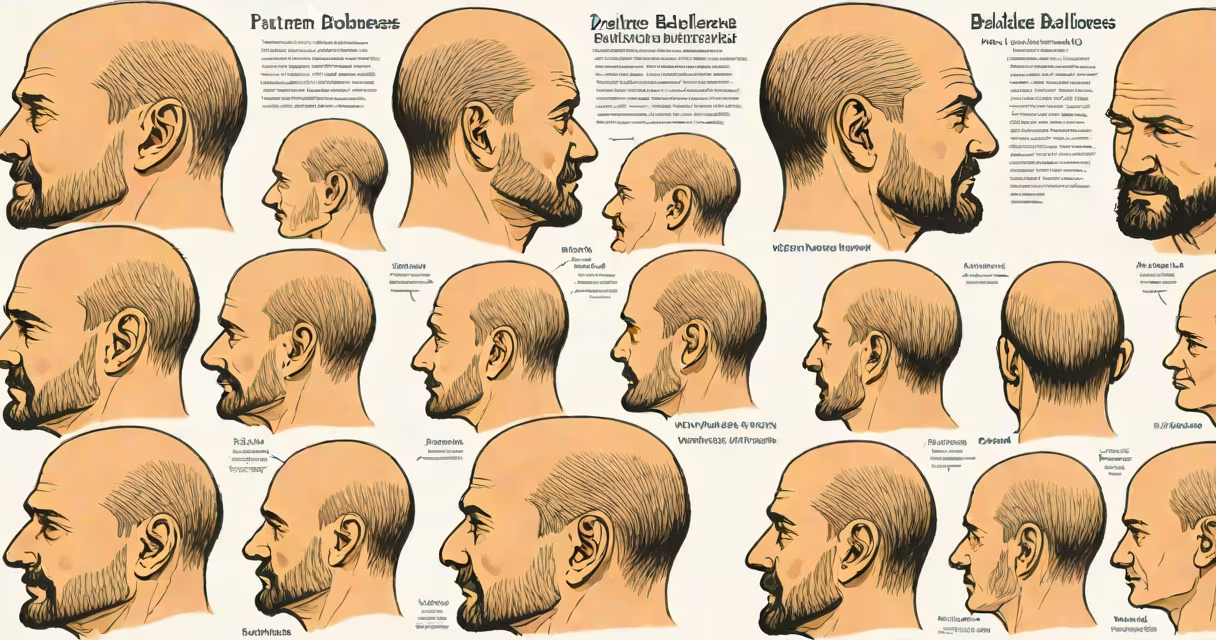
Pattern baldness refers to predictable hair loss patterns caused by genetic factors and hormones. The two main types are male pattern baldness (androgenetic alopecia) and female pattern baldness, which develop differently.
Pattern baldness occurs when hair follicles shrink due to sensitivity to dihydrotestosterone (DHT), a hormone derived from testosterone. This process, called miniaturization, gradually shortens the hair growth cycle until new hairs stop growing.
The Norwood-Hamilton scale classifies male pattern baldness into seven stages based on recession at the temples and thinning at the crown. Female pattern baldness follows the Ludwig scale, with three stages describing diffuse thinning across the top of the scalp.
| Type | Common Name | Primary Affected Area | Typical Progression |
|---|---|---|---|
| Male Pattern Baldness | Androgenetic Alopecia | Temples and crown | Receding hairline, eventual bald spot |
| Female Pattern Baldness | Androgenetic Alopecia | Top and crown | Diffuse thinning, wider part |
Male pattern baldness typically begins with a receding hairline at the temples, forming an M-shaped pattern. Over time, this progresses to a U-shaped bald spot at the crown. About 50% of men experience significant hair loss by age 50.
Female pattern baldness usually starts with diffuse thinning at the part line, widening it over time. Unlike men, women rarely develop a completely bald spot. The condition affects about 40% of women by age 60.
Many people believe pattern baldness only affects older adults, but it can begin as early as the late teens or early 20s. Another myth is that wearing hats causes hair loss - pattern baldness is primarily genetic and hormonal.
Contrary to popular belief, frequent shaving doesn't accelerate hair loss. The misconception likely arises because closely shaved hair appears more sparse than longer hair.
FDA-approved treatments for pattern baldness include minoxidil (Rogaine) and finasteride (Propecia). Minoxidil works by prolonging the hair growth phase, while finasteride blocks DHT production. Both require continuous use to maintain results.
For those seeking permanent solutions, hair transplantation can redistribute hair from donor areas to balding regions. Laser therapy and platelet-rich plasma (PRP) treatments show promise but require more research.
I've seen firsthand how effective minoxidil can be for some patients. One client, a 32-year-old man with early-stage male pattern baldness, regained noticeable hair density after six months of consistent use.
To learn more about reversing pattern baldness, explore treatment options that may help slow or stop hair loss. Understanding how male pattern baldness is inherited can also provide insights into your own risk factors.